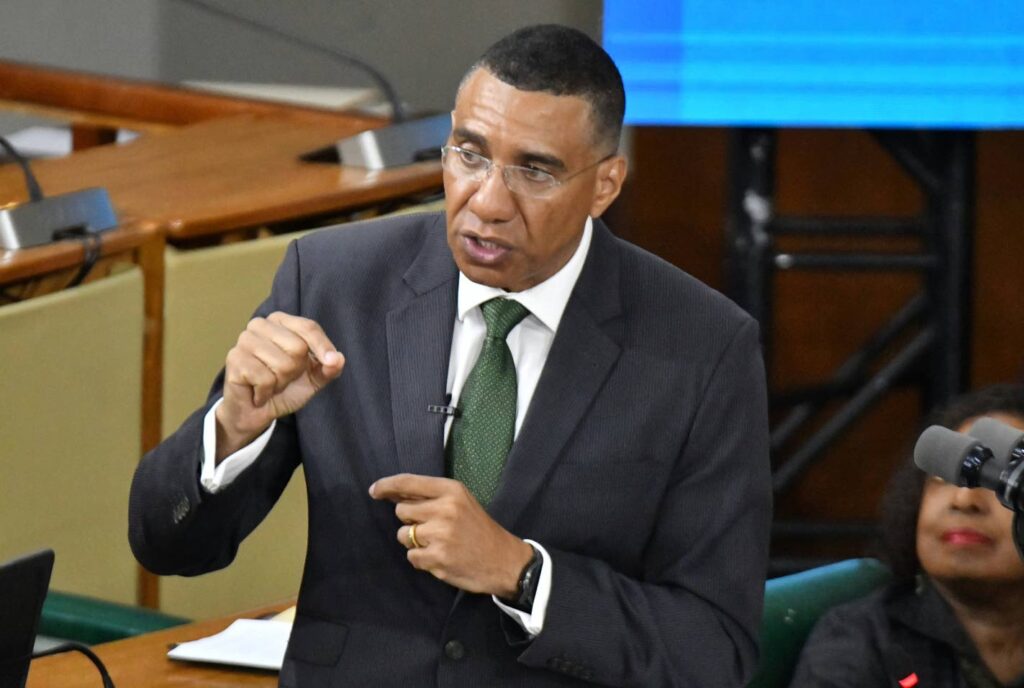
Prime Minister Andrew Holness has articulated a comprehensive national security doctrine positioning Jamaica’s declining homicide statistics as evidence of systematic success against organized criminal networks. Addressing the 4th Annual Security Seminar in New Kingston, Holness detailed how strategic interventions have disrupted gang leadership architectures, constrained illicit financing channels, and diminished criminal territorial dominance.
The Prime Minister framed national security resilience as the central organizing principle of Jamaica’s strategy, emphasizing that temporary gains require permanent consolidation. “Communities formerly governed through fear must become structurally and permanently inhospitable to criminal return,” Holness asserted, outlining prerequisites including secure public spaces, reliable infrastructure, ordered development, lawful economic opportunities, and consistent state presence.
Holness presented Hurricane Melissa’s Category 5 impact in October as a paradigm-shifting national security event that claimed 45 lives and affected 760,000 citizens. While praising the Jamaica Defence Force’s response demonstrating enhanced joint planning and civil-military coordination, he revealed critical vulnerabilities: stretched logistical chains, strained maintenance capacity, and border security assets diverted to humanitarian relief.
The crisis illuminated Jamaica’s persistent capability gaps despite tripled security budgets. “There are threats we could face for which we don’t have assets to respond,” Holness acknowledged, declaring climate shocks permanent features of Jamaica’s security landscape rather than episodic emergencies.
Holness articulated disasters as strategic shocks that redirect resources, stress institutions, disrupt logistics, and create opportunities for illicit trafficking and irregular migration. Following Melissa’s destruction of police stations and government buildings, he noted with pride the uninterrupted policing services through human resource resilience.
The Prime Minister integrated border security into this framework, highlighting Jamaica’s position in one of the hemisphere’s most trafficked maritime corridors. He detailed adaptive trafficking methodologies utilizing containerized cargo, clandestine airstrips, UAVs, and semi-submersibles, with narcotic routes increasingly converging with irregular migration networks.
Citing 2025 interdictions of 33,000 kg of marijuana and 1,360 kg of cocaine, plus 990 pounds of cocaine valued at $3.7 billion intercepted by Coast Guard units, Holness connected border security directly to national stability. The documentation of 124 irregular migrant entries primarily from Haiti and Cuba demonstrated additional humanitarian, legal, and resource challenges for the island nation.
Holness concluded that national security institutions must develop capacities to “anticipate, absorb, adapt, and recover from shocks” across criminal, environmental, and geopolitical domains, with disaster risk management fully integrated into security planning, budgeting, and capability development.