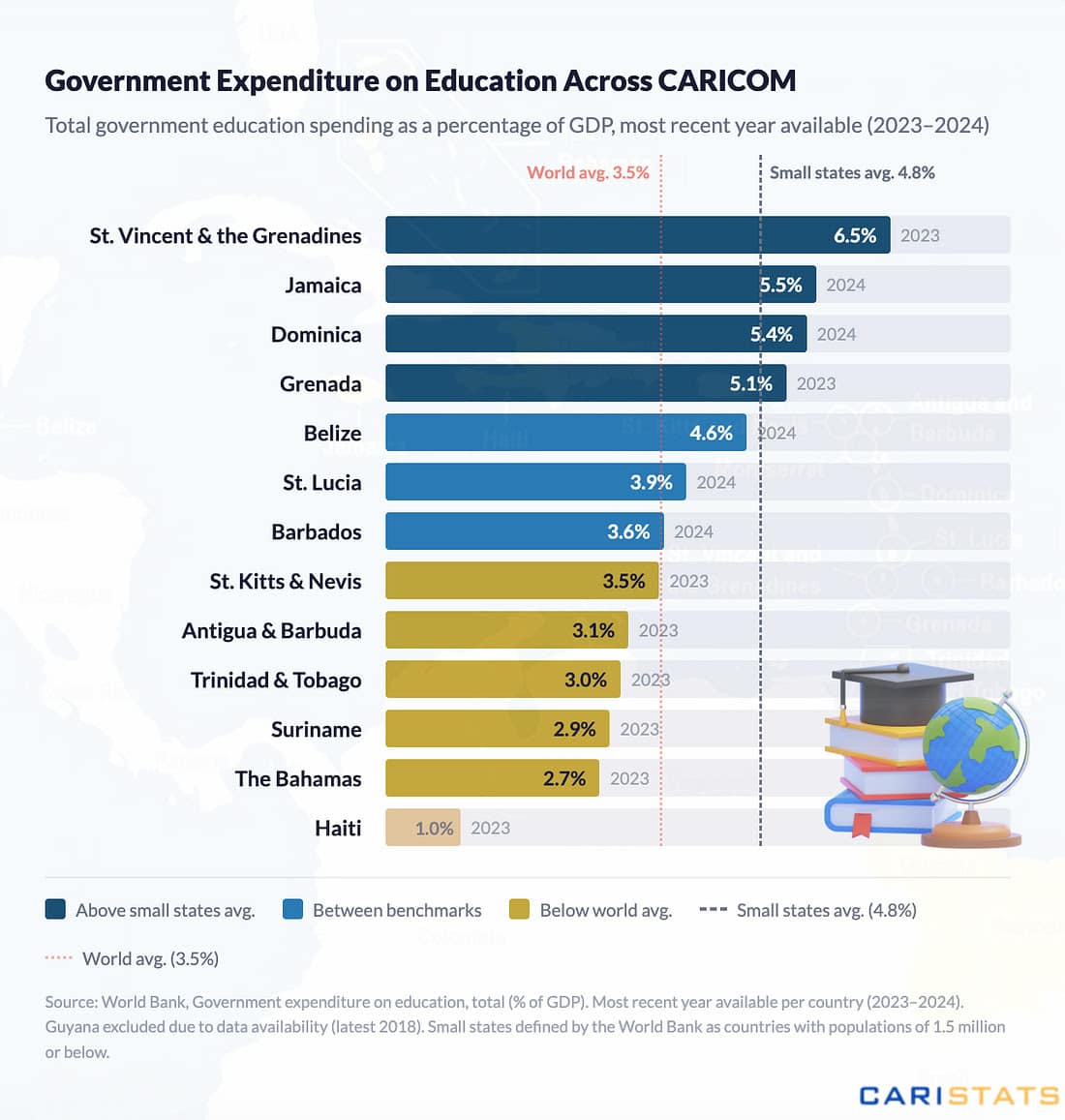
A comprehensive analysis of education funding across CARICOM member states reveals significant disparities in governmental commitment to educational development. While seven nations exceed the global average expenditure of 3.5% of GDP, six member states plus Haiti—which allocates less than 1%—fall substantially below this international benchmark.
Leading the regional education investment ranking is St. Vincent and the Grenadines with a notable 6.5% of GDP dedicated to education, followed closely by Jamaica (5.5%), Dominica (5.4%), and Grenada (5.1%). A middle cohort comprising Belize, St. Lucia, and Barbados maintains spending above the world average but below the 4.8% threshold recommended for small states facing structural challenges comparable to Caribbean nations.
The lower investment tier includes St. Kitts and Nevis, Antigua and Barbuda, Trinidad and Tobago, Suriname, and The Bahamas, all falling short of the global average. Particularly concerning is Suriname’s dramatic education budget reduction, which has nearly halved from 5.5% to 2.9% since 2015 amid mounting fiscal constraints. Barbados and Trinidad and Tobago have similarly witnessed declines exceeding one percentage point during the same period.
In contrast, Dominica and St. Vincent and the Grenadines have demonstrated increased educational investment since 2015. This financial data emerges as regional discussions have predominantly centered on educational outcomes including examination results, curriculum development, and instructional quality. The new expenditure analysis suggests that resource allocation and funding mechanisms warrant equivalent consideration in policy dialogues.
Data sourced from World Bank records on government education expenditure (most recent 2023-2024 figures) excludes Guyana due to insufficient current statistics. The World Bank defines small states as nations with populations under 1.5 million, representing a relevant comparison group for Caribbean development strategies.