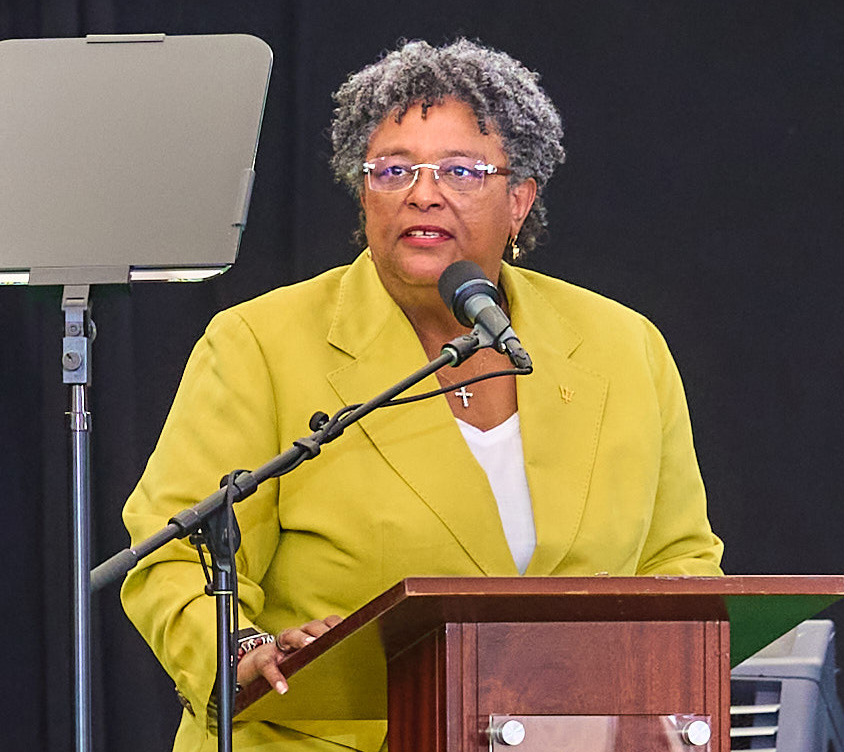
Prime Minister Mia Mottley has presented a comprehensive justification for her newly appointed 26-member Cabinet, characterizing its expanded structure as a deliberate strategic framework designed to enhance governmental efficiency and accountability. During Monday’s swearing-in ceremony at CARIFESTA House, where ministers and senators took their oaths before President Jeffrey Bostic, Mottley articulated a vision of governance centered on execution rather than political symbolism.
The Cabinet configuration includes three ministers of state and several newly elevated portfolios reflecting the administration’s priority areas. Mottley emphasized that dedicated ministries for Public Service and Talent Development, Investment, and Economic Affairs represent core pillars of Barbados’ development strategy. “The public service constitutes our primary delivery engine,” Mottley stated. “Barbados’s next developmental phase will ultimately succeed or falter based on service quality enhancement.”
Regarding the investment portfolio, Mottley highlighted economic resilience concerns: “While tax collection performance remains satisfactory, our tax base continues to demonstrate tenuous characteristics. Our sustained progress fundamentally depends on accelerating both domestic and foreign investment inflows.”
The Cabinet retains several key figures while introducing strategic reassignments. Santia Bradshaw continues as Deputy Prime Minister overseeing Environment, National Beautification and Fisheries. Senator Jerome Walcott assumes responsibility for Social and Environmental Policy coordination, while Kerrie Symmonds takes charge of Energy, Business Development and Commerce. Notable appointments include Ryan Straughn maintaining Finance, Kay McConney leading Public Service and Talent Development, and Senator Lisa Cummins directing Health and Wellness.
Mottley simultaneously announced plans to establish a National Competitiveness Commission, characterizing it as a practical mechanism to identify and resolve systemic obstacles across sectors from tourism to street vending. Addressing public frustrations with service delivery, she acknowledged: “Citizens evaluate governance not through policy documents but through lived experiences—transport reliability, road safety, and utility consistency.”
The Prime Minister concluded by emphasizing collaborative reform, noting that transformational progress requires concerted efforts beyond the political class: “Barbados necessitates world-class public service standards. Every public servant must provide exemplary service to both citizens and visitors alike.”