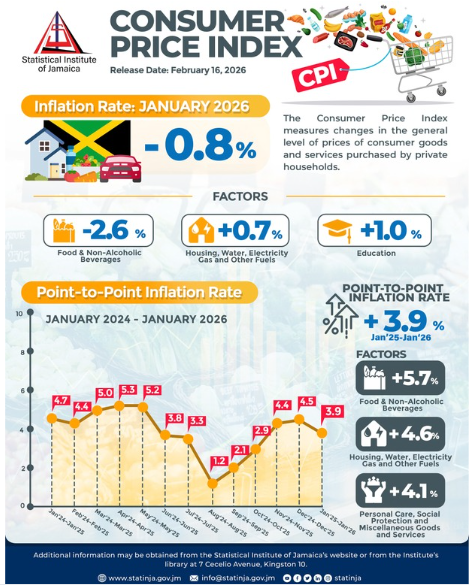
KINGSTON, Jamaica — Jamaica experienced a notable deflationary trend in January 2025, with official statistics revealing a 0.8% contraction in consumer prices primarily driven by a substantial downturn in food costs. The Statistical Institute of Jamaica (STATIN) reported this unexpected price decline while noting that annual inflation metrics remained comfortably within the central bank’s target parameters.
The comprehensive Consumer Price Index (CPI) reduction stemmed largely from a significant 2.6% plunge in the Food and Non-Alcoholic Beverages sector. This downward trajectory was particularly evident in fresh produce categories, where vegetables, tubers, plantains, cooking bananas, and pulses collectively plummeted by 9.9%. The dramatic price correction reflects enhanced domestic agricultural output and improved supply chain dynamics. Additionally, ready-made food products witnessed an 8.4% price contraction, with notable decreases observed across multiple staple items including cabbage, carrot, cucumber, escallion, sweet pepper, and tomato.
Counteracting these deflationary pressures, the Housing, Water, Electricity, Gas and Other Fuels index advanced by 0.7%, primarily due to adjusted water supply and sewage tariffs. The Education sector experienced a 1.0% price increase driven by elevated preparatory school fees.
Regional analysis confirmed consistent deflation patterns across all geographic divisions. The Greater Kingston Metropolitan Area registered a 0.6% price decline, while Other Urban Centres and Rural Areas recorded decreases of 0.8% and 1.0% respectively.
The current deflationary episode follows substantial inflationary pressures in preceding months, including a 1.3% increase in December and a 2.4% surge in November, highlighting the volatile nature of food-driven price movements in the Jamaican economy.
Despite the monthly contraction, annualized metrics reveal persistent inflationary trends across key sectors. Food prices accumulated a 5.7% increase over the twelve-month period, with fish and seafood products soaring by 12.6%. Housing costs advanced 4.6% annually, while personal care and miscellaneous goods rose by 4.1%.
The point-to-point inflation rate spanning January 2025 to January 2026 stabilized at 3.9%, indicating maintained alignment with monetary policy objectives. The Consumer Price Index continues to serve as the primary gauge for measuring price fluctuations in goods and services acquired by private households across Jamaica.