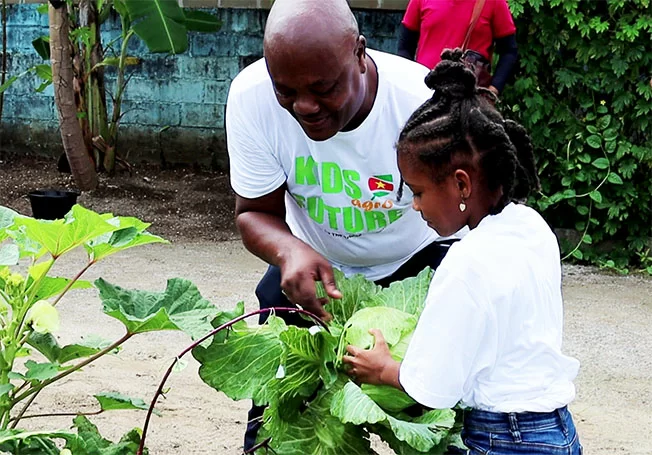
In a remarkable initiative blending agricultural education with practical experience, eight children from Kasabaholo have successfully harvested their first crop after three months of dedicated farming. The Kids Agro Future project, spearheaded by The Bridge Diaspora organization, has yielded impressive results including football-sized cabbages, perfect okra for soup, and spinach with remarkably large leaves.
Orlando Cairo, one of the driving forces behind the initiative, expressed profound pride in the children’s accomplishments. “They have performed excellently. I was truly astonished myself,” Cairo remarked. The program combines theoretical knowledge with practical mini-GAP (Good Agricultural Practices) training, already convincing three participants to pursue agricultural careers.
The project’s methodology emphasizes systematic agricultural practices. Participants receive seeds to plant at home while meticulously documenting planting dates, seed depth, watering frequency, and germination progress. “You can see their joy when the first seedling emerges,” Cairo noted, emphasizing the need for more opportunities for children to engage actively with agriculture.
Suriname’s Minister of Agriculture, Livestock and Fisheries, Mike Noersalim, has thrown his full support behind the initiative. During a meeting with the young farmers, he highlighted agriculture’s critical role in the nation’s future. “Without agriculture and livestock, we face significant problems. We cannot survive without food. You are not only the future but also ensuring that future by choosing agriculture,” Minister Noersalim told the children.
The ministry is actively pursuing collaborations with organizations and educational institutions including Natin, PTC, and potentially Anton de Kom University of Suriname to encourage youth engagement in agriculture. Minister Noersalim encouraged participants to “choose a direction not just because it generates income, but primarily because you have passion for it.”
Project coordinator John van der Zijden emphasized how modern technological developments are making agriculture more attractive and efficient. “The traditional tools alone are no longer sufficient. We must work more efficiently and implement new technology,” he stated. Van der Zijden demonstrated drone technology for digital irrigation and remote crop monitoring, along with innovative water conservation techniques increasingly vital in times of climate change.
Through this combination of hands-on experience, knowledge transfer, and modern technology, the initiative aims to inspire young people toward sustainable agricultural careers, potentially addressing future food security challenges while revitalizing Suriname’s agricultural sector.