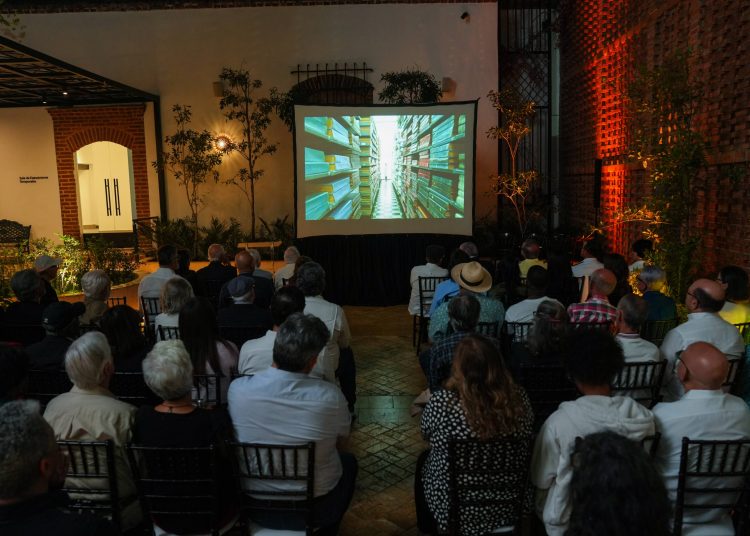
Santo Domingo’s Taíno Cultural Center Casa del Cordón, an institution supported by Banco Popular Dominicano, recently presented a special screening of the documentary ‘Galeones de Azogue.’ The film chronicles the pioneering underwater archaeological investigations in the Dominican Republic that began with the discovery of the Azogue Fleet galleons, which met their fate off the coast of Miches during the 18th century.
The event, organized in partnership with Spain’s Royal Shipyards Museum, featured a distinguished panel including the museum’s director Íñigo Apestegui and screenwriters Carlos León and Cruz Apestegui. They provided exclusive insights into the documentary’s extensive research methodology, historical documentation, and groundbreaking findings that shaped this significant archaeological investigation.
Produced through a collaboration between Duho Cinema, Retama Studio, and Guasabara Cine, the documentary was spearheaded by general producers Fernando Santos and Gabriel Valencia. The technical team included editor Mikel D. Etxebarría and sound designer Laura Gantes. The film incorporates expert commentary from renowned specialists Pedro Borrel, Frank Moya Pons, Bernardo Vega, Federico Schad, Jaime Vega, and Tracy Bowden.
The documentary traces the accidental discovery in 1976 by local Miches fishermen of two submerged galleons in Samaná Bay. This chance finding catalyzed the nation’s first official underwater archaeological expedition, unearthing artifacts connected to a maritime catastrophe that occurred over three centuries earlier.
Historical records indicate that on August 24, 1724, the galleons Nuestra Señora de Guadalupe and Tolosa—part of the Mercury Fleet voyaging from the Iberian Peninsula to the Viceroyalty of New Spain (modern-day Mexico)—encountered a devastating storm. The vessels were transporting more than 360 tons of mercury from Spain’s Almadén mines, a crucial component in colonial silver processing. While the Guadalupe sustained severe damage, the Tolosa sank entirely off the Dominican coastline.
The tragedy claimed more than 600 lives, with survivors enduring extreme hardships—some clinging to ship masts for weeks, others navigating treacherous jungles and beaches in search of rescue—leaving behind a profound narrative of human endurance.
Archaeological work recommenced in 1994 through a cooperative Dominican-Spanish initiative, representing a watershed moment for the nation’s maritime heritage preservation. The Quicksilver Galleons Project successfully recovered over 45,000 artifacts, including cannons, navigational equipment, coins, personal belongings, and an exceptional assemblage of European glassware. These discoveries have significantly enriched understanding of colonial trade networks and 18th-century maritime practices while establishing the foundation for Dominican underwater archaeology, enabling the nation to reclaim and safeguard its submerged historical legacy as an integral component of its cultural identity.