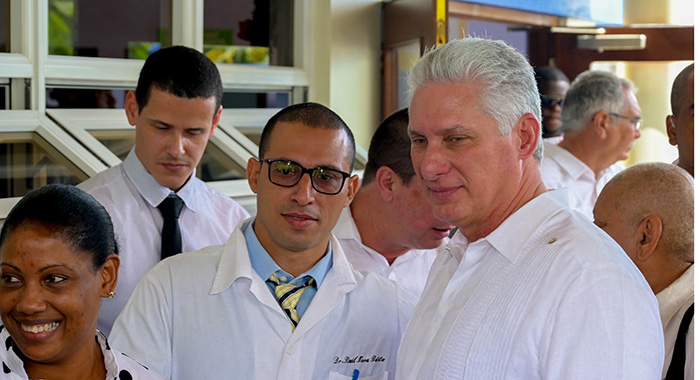
KINGSTOWN, St. Vincent – Prime Minister Godwin Friday has unveiled a transformative healthcare strategy that includes phasing out reliance on Cuban medical personnel over a three-year period. The announcement came during the presentation of the nation’s first EC$1.9 billion budget since the New Democratic Party’s electoral victory last November.
The move follows recent statements from the United States condemning Cuba’s medical missions as “forced labour schemes” and urging regional governments to terminate their participation. While Prime Minister Friday did not explicitly link the phase-out to US pressure, the timing coincides with Washington’s intensified campaign against Cuba’s international medical programs.
Under the “Medical Staffing Localisation” initiative, St. Vincent will recruit four local medical officers in 2026 to begin replacing Cuban District Medical Officers, addressing both language barriers and reducing foreign staffing costs. “They may be redeployed elsewhere as needed,” Friday stated during his parliamentary address.
The health sector allocation of EC$117.5 million reflects what the Prime Minister described as “a holistic vision that nurtures mind, body, and spirit while safeguarding environmental services.” He emphasized that “access to affordable, high-quality healthcare is not merely a social service; it is a strategic investment in growth.”
The government’s reform agenda confronts a severe public health crisis revealed by the 2023 Census, showing 12,239 hypertension cases and 7,039 diabetes cases nationwide. Friday characterized non-communicable diseases as a “silent epidemic” that reduces quality of life and strains healthcare resources.
Preventive measures will include cancer screening for breast, cervical, prostate, and colon cancers at all primary healthcare centers. Additionally, EC$1 million has been allocated to a Patient Support Unit for coordinating overseas radiotherapy and other critical interventions.
The administration is implementing a comprehensive Health Information System supported by a six-million-dollar grant from Taiwan, digitizing medical records to enable data-driven planning and accountability. The system modernization complements policy revisions to strengthen mental health services and enhance geriatric care facilities.
“Our reform agenda is grounded in risk mitigation, self-reliance, and institutional strength,” Friday declared. “We are building a system that is resilient to shocks and responsive to local needs.”