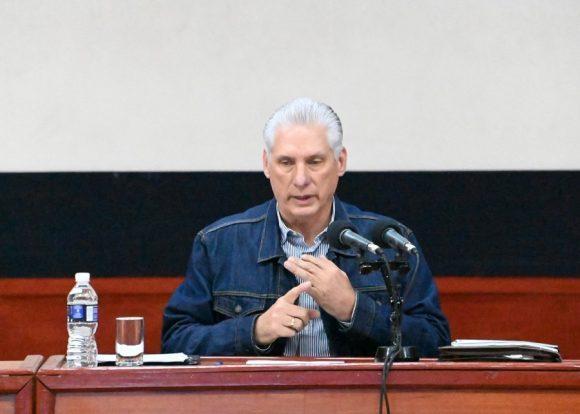
In a nationally televised address, Cuban President Miguel Díaz-Canel delivered a comprehensive response to mounting pressures from the United States, addressing critical questions about Cuba’s international relations, energy security, and national survival strategies. The presentation, broadcast across state media platforms, came amid heightened tensions following US military actions against Venezuela and intensified economic measures against Cuba.
Díaz-Canel categorically rejected US characterizations of Cuba as a ‘failed state,’ asserting instead that Cuba represents a resilient nation successfully resisting ‘maximum pressure from the world’s leading power.’ He framed current difficulties as the result of prolonged economic warfare rather than systemic failure, emphasizing that ‘most current generations of Cubans were born under the US economic blockade.’
Regarding Cuba-Venezuela relations, the president dismissed notions of dependency, describing the partnership as one of ‘comprehensive cooperation’ spanning energy, education, healthcare, and cultural exchange. He detailed how the relationship evolved from bilateral cooperation into regional initiatives like ALBA-TCP and Petrocaribe, while acknowledging that recent US sanctions have significantly impacted fuel shipments from Venezuela.
The Cuban leader revealed receiving substantial international support, mentioning specific backing from Russia and China alongside solidarity from ‘governments, institutions, and companies’ worldwide. He noted that many support mechanisms remain confidential due to active US efforts to block assistance channels.
Díaz-Canel characterized US actions as part of a broader ‘ideological, cultural, and media war’ against sovereign nations, urging Global South countries to strengthen multilateral cooperation through blocs like BRICS, the Eurasian Union, and the Non-Aligned Movement. He drew historical parallels to fascist tactics, stating US actions resemble ‘Hitler’s hordes when they attack a country.’
On US-Cuba relations, the president reaffirmed Cuba’s historical openness to dialogue ‘without preconditions and on equal terms.’ He identified multiple potential cooperation areas including migration, security, environmental protection, and scientific exchange, while insisting that dialogue must occur without pressure and with respect for Cuban sovereignty.
The address concluded with a call for national unity and ‘creative resistance,’ emphasizing that Cuba would overcome current challenges through collective effort and international solidarity despite unprecedented economic pressure.