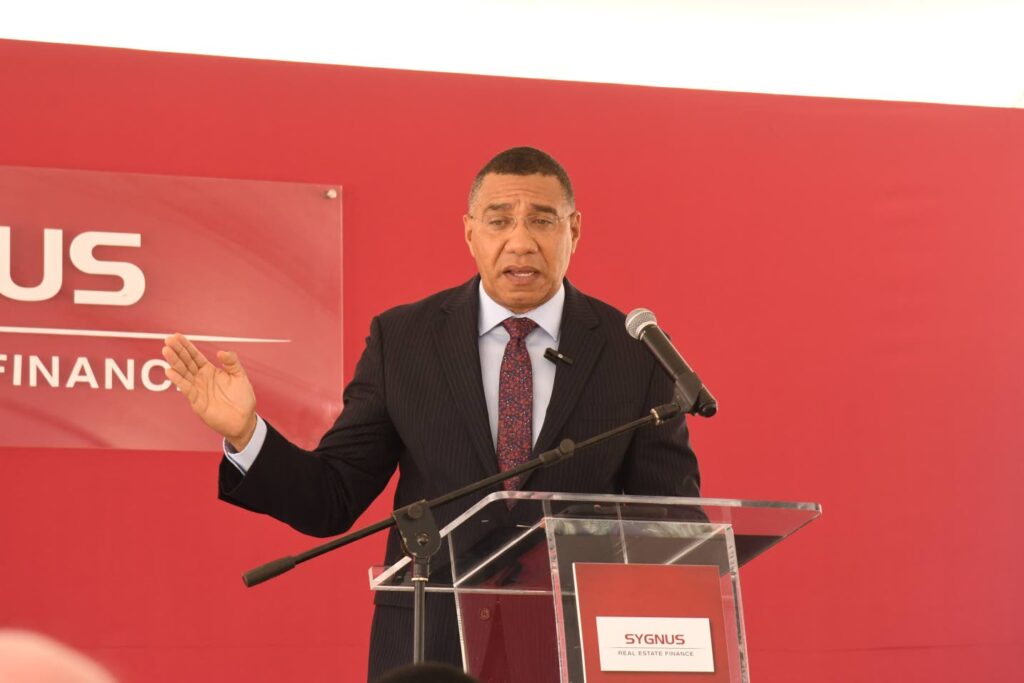
In a landmark address at the Jamaica Stock Exchange conference, Prime Minister Andrew Holness unveiled a transformative economic strategy signaling a decisive pivot from Jamaica’s post-crisis policies of the past quarter-century. The comprehensive vision encompasses energy sector reform, financial regulatory modernization, and enhanced regional integration to position Jamaica for sustained growth in a volatile global landscape.
The government has initiated critical negotiations with the Jamaica Public Service Company (JPSCo) ahead of its license expiration in 2027, targeting substantial reductions in electricity costs through expanded renewable energy capacity and improved grid resilience. This energy initiative forms a cornerstone of Jamaica’s productivity enhancement agenda, particularly crucial for small island economies facing disproportionate energy constraints.
Most significantly, Prime Minister Holness articulated a fundamental philosophical shift in financial regulation, arguing that Jamaica’s post-Finsac framework—originally designed for risk containment—must now evolve to enable opportunity and innovation. Emphasizing that regulatory frameworks shouldn’t be ‘frozen in time,’ he proposed recalibrating financial architecture to support expansion while maintaining stability as a ‘non-negotiable’ foundation.
This regulatory modernization is justified by Jamaica’s dramatically improved macroeconomic position, characterized by substantially reduced public debt, robust external reserves, and credible fiscal anchors. The prime minister noted that Jamaica’s deeper, more sophisticated capital markets now require regulations aligned with evolving risk profiles and financial innovation, advocating for ‘smart regulation’ that unlocks capital while preserving financial soundness.
Concurrently, Jamaica is asserting leadership within regional economic forums, recently standing out as the only CARICOM nation highlighted at the International Investment Forum in Panama—the region’s equivalent of Davos. Former Inter-American Development Bank executive Gerard Johnson observed that Jamaica’s ministers effectively showcased the nation’s successful risk management policies and recovery strategies from external shocks.
The forum highlighted both challenges and opportunities for Latin American and Caribbean (LAC) nations, which risk being left behind due to slow growth, low productivity, and high debt vulnerability. Prime Minister Holness joined regional leaders in calling for reduced trade barriers and new economic alignments, particularly relevant for CARICOM’s Single Market and Economy, which may require reassessment to ensure it doesn’t hinder diversification and sustainable growth.
This comprehensive economic repositioning occurs against a backdrop of what academics term a ‘global polycrisis’—where climate events, geopolitical tensions, supply-chain disruptions, and financial volatility overlap and reinforce one another. Jamaica’s strategy represents a proactive adaptation to this fractured global environment, seeking to transform stability into a platform for expansion rather than treating it as a developmental ceiling.