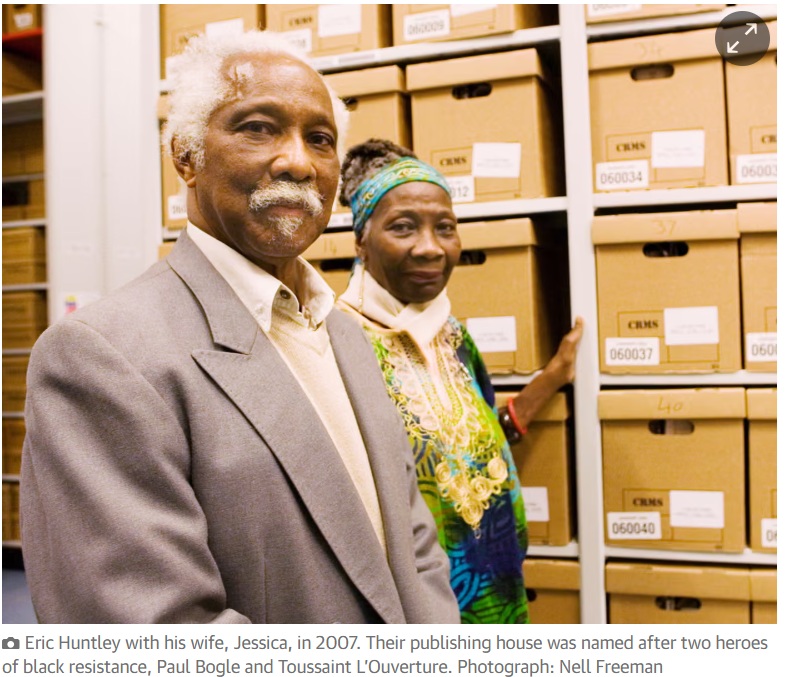
Eric Huntley, the Guyanese-born co-founder of Britain’s seminal black publishing house Bogle L’Ouverture and a lifelong campaigner for racial equality, has passed away at age 96. Alongside his wife Jessica, Huntley established the radical publishing venture in 1968 from their West London living room, creating a crucial platform for underrepresented black authors and intellectuals.
The publishing house, named after Jamaican national hero Paul Bogle and Haitian revolutionary Toussaint L’Ouverture, rapidly evolved from a makeshift printing operation into both a respected publishing imprint and community hub. The Huntleys’ Ealing-based bookshop became an informal advice center and gathering place for London’s black community, championing writers including Linton Kwesi Johnson, Valerie Bloom, and Beryl Gilroy.
Beyond publishing, Huntley dedicated decades to racial justice activism. He played instrumental roles in the Caribbean Education and Community Workers Association and the Black Parents Movement, organizations formed to combat systemic racism in education and policing. His activism extended to organizing the 1981 Black People’s Day of Action following the New Cross fire tragedy that claimed 14 young black lives.
Born in 1929 Georgetown, British Guiana, Huntley’s political consciousness developed early through his involvement with the People’s Progressive Party and Marxist leaders Cheddi and Janet Jagan. His activism led to imprisonment in 1954 for curfew violation during British colonial rule’s state of emergency.
Seeking stability, Huntley migrated to Britain in 1957, working as a postal sorter while saving to bring his family from Guyana. The couple’s publishing venture began distributing speeches by influential Guyanese scholar Walter Rodney, growing into a respected imprint that published groundbreaking works despite repeated racist attacks during the National Front’s peak influence.
The Huntleys’ archives now reside at London Metropolitan Archives, preserving their legacy of cultural activism. Eric Huntley continued community advocacy into his tenth decade, maintaining that ‘the struggle never ends.’ He is survived by two children, nine grandchildren, and numerous great-grandchildren.