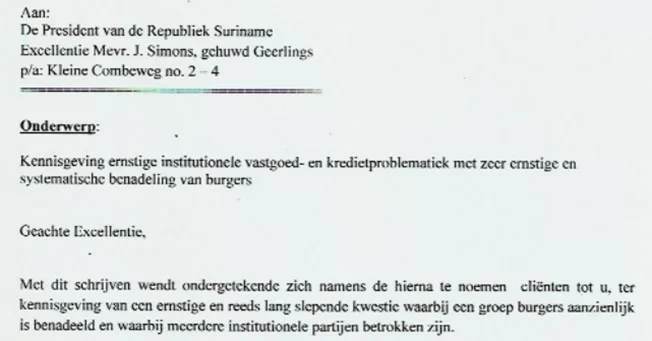
A group of Surinamese citizens who purchased fully paid residential plots in a subdivision project along Frederikshoopweg have been stranded for years without proper ownership titles, prompting presidential intervention. The case, now before President Jennifer Simons, reveals a complex web of financial and legal irregularities involving major national institutions.
Eleven affected buyers, represented by Vreden & Partners Legal Consultancy, detailed their plight in a formal communication to the presidency. These individuals acted in good faith, completed full payment for their parcels, and in some cases even constructed homes, yet remain unable to obtain legal ownership due to an unresolved mortgage encumbrance on the parent property.
The core controversy stems from the mortgage’s questionable origination. In August 2010, The Surinamese Trust Company N.V., a subsidiary of De Surinaamsche Bank (DSB), issued a credit commitment on behalf of three parties including Assuria Damage Insurance N.V. However, the subsequent notarial deed registered the mortgage exclusively under Assuria Life Insurance N.V.—an entity conspicuously absent from the original credit agreement.
Two years later in 2012, the mortgage underwent “rectification” with claims that the original creditor designation was erroneous. The buyers contend this explanation lacks credibility, noting that creditor identification constitutes a fundamental component of mortgage documentation. Their legal representatives suggest potential “deliberate retroactive structural modification” in official correspondence.
The persistent mortgage blockage continues despite the Ministry of Public Works having approved the land subdivision in May 2011, legally converting the property into sixty individual plots. The involvement of heavily regulated institutions deepens the mystery: DSB operates as a systemically important bank under Central Bank of Suriname supervision, while Assuria represents one of the nation’s largest insurance groups and long served as DSB’s major shareholder. The State of Suriname itself holds shares in DSB.
Given this institutional landscape, the buyers’ counsel argues that claims of ignorance or simple administrative error remain implausible. The emphasis falls on the stringent care and compliance obligations that life insurers and banks bear precisely for third-party protection.
The Central Bank of Suriname has declined jurisdiction in the matter, compelling the homeowners to seek presidential assistance in directing relevant authorities to address the situation. Meanwhile, the affected citizens endure profound uncertainty—having invested financially and emotionally in properties that legally remain beyond their grasp.