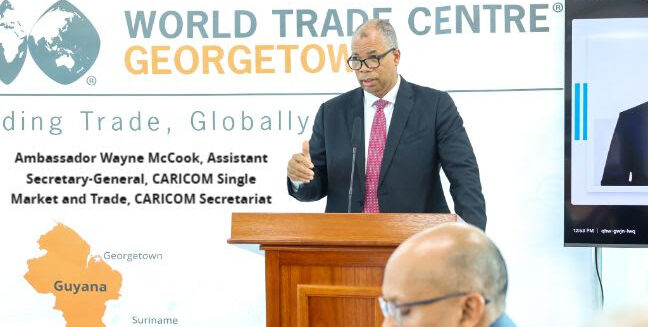
A senior Caribbean Community (CARICOM) official has declared that strengthening regional integration represents a vital strategic countermeasure against an increasingly volatile and fragmented global trading system. Ambassador Wayne McCook, Assistant Secretary-General for the CARICOM Single Market and Trade, articulated this position during a panel discussion at the World Trade Centre in Georgetown, Guyana, on January 28.
Addressing the theme “Prospects for International Trade in 2026,” Amb. McCook framed regional cohesion as essential for building resilience. He pointed to recent crises, including the devastating Hurricane Melissa, as emblematic of the dual challenges confronting member states: climate-related existential threats and profound economic vulnerabilities. These domestic pressures are compounded by dramatic shifts in international trade, which the ambassador attributed significantly to an intensified “America First” policy framework that has disrupted Caribbean exports and supply chains through unprecedented tariff measures.
Characterizing 2025 as a period of exceptional turbulence, McCook cited alarming global trends: an 11% contraction in foreign direct investment in 2024 (marking a second consecutive annual decline) and global trade growth slowing to below 1% in 2025, according to UNCTAD data. Despite this adverse international environment, CARICOM has demonstrated remarkable economic resilience, with community exports surging by 32% between 2023 and 2024 to approximately US$34.7 billion, including an 86% increase in exports to the United States.
The ambassador highlighted recent initiatives toward complete free movement of people by Barbados, Belize, Dominica, and St. Vincent and the Grenadines as tangible progress toward integration. Looking forward, he proposed a comprehensive 2026 strategy centered on bolstering intra-regional commerce, maintaining international partnerships while diversifying beyond traditional allies, and deepening economic integration. Key to this approach is implementing the CARICOM Industrial Policy and Strategy (CIPS) and the 25×25+5 food security initiative designed to reduce import dependency and promote regional agricultural self-sufficiency.
“Fundamentally,” McCook concluded, “CARICOM integration should be seen as a strategic response to a shifting global order.”