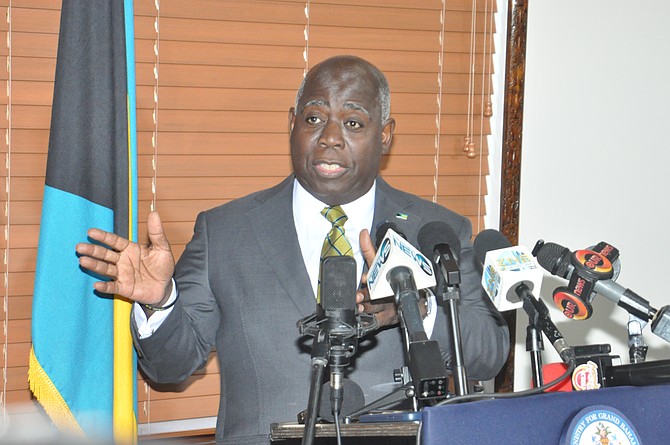
The Bahamian government is confronting severe criticism following Prime Minister Philip Davis KC’s announcement of a memorandum of understanding with Canadian energy giant Emera regarding the potential acquisition of Grand Bahama Power Company. The disclosure has sparked accusations of political theater and creating false hope among residents.
Darren Cooper, a prominent Grand Bahama business owner and radio personality, characterized the government’s actions as treating citizens like ‘puppets’ by announcing preliminary discussions as a finalized deal. Cooper drew parallels to last year’s Grand Lucayan agreement, which remains uncompleted, suggesting a pattern of premature announcements without substantive details.
The controversy intensified when Dave McGregor, Emera’s Caribbean chief operating officer, revealed in a staff communication that both local and Bahamian management were completely blindsided by the Prime Minister’s announcement. McGregor explicitly stated that while discussions about a possible government acquisition option were ongoing, ‘no final agreement’ had been reached, directly contradicting the government’s presentation.
Energy sector analysts note that the proposed acquisition faces significant challenges, particularly given Emera’s status as a publicly-traded company subject to Canadian and US securities regulations. The Prime Minister’s announcement timing—suggesting a 60-90 day closing window—appears particularly optimistic without Emera’s formal agreement.
Grand Bahama residents expressed widespread skepticism, citing the government’s troubled track record with Bahamas Power & Light (BPL). Environmental advocate Joe Darville voiced concerns about reliability guarantees, noting that while GB Power has faced recent service challenges, residents have grown accustomed to relatively consistent power compared to other islands.
Opposition Leader Michael Pintard questioned the government’s capacity to improve energy services, stating: ‘The government has a record of failure around BPL in multiple places in The Bahamas, which does not give us confidence that they will do a better job.’ The announcement has raised fundamental questions about acquisition costs, potential partners, and how the government intends to address Grand Bahama’s specific energy challenges beyond political pronouncements.