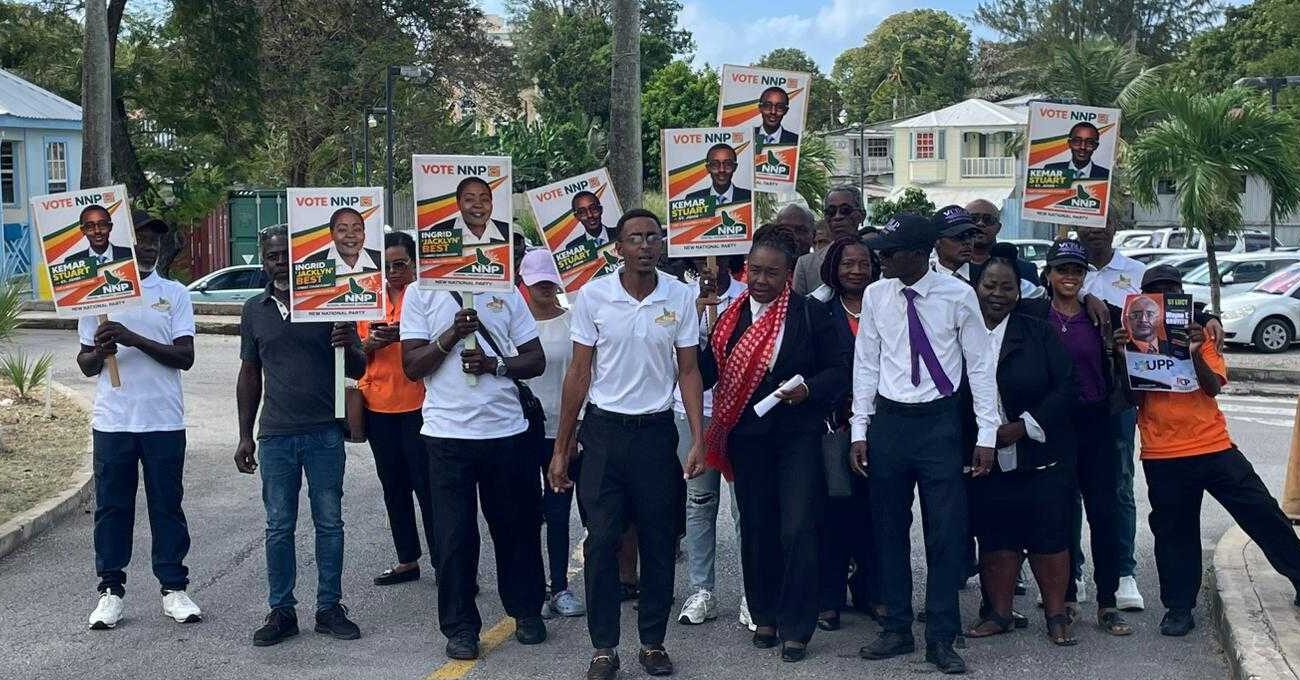
A new political force has formally entered Barbados’s electoral arena as the People’s Coalition for Progress (PCP) confirmed its participation in the February 11 general election. The alliance, comprising the New National Party (NNP), United Progressive Party (UPP), and Conservative Barbados Labour Party (CBLP), has nominated fifteen candidates across half the available constituencies, positioning itself as a viable alternative to the established two-party dominance.
The coalition’s candidates completed their nomination process Monday at the Treasury offices within the National Housing Corporation on Country Road, each submitting the mandatory $250 electoral deposit. This procedural step finalized the PCP’s electoral lineup just weeks before the nation heads to the polls.
NNP leader Kemar Stuart, contesting the St John constituency, expressed strong confidence in his campaign’s trajectory. He faces Democratic Labour Party (DLP) leader Ralph Thorne and incumbent Barbados Labour Party (BLP) representative Charles Griffith. “Our campaigning in St John has been exceptional,” Stuart stated. “The public response has exceeded expectations, and we are anticipating victory.” Stuart further criticized his opponent Thorne for switching constituencies and advocated for reducing the number of parliamentary seats to cut government expenditure.
Across the coalition, candidates highlighted diverse motivations for their political engagement. Patsy Nurse, PCP candidate for St Michael West, cited constituent dissatisfaction with current representation as her primary impetus. “The elderly and people with disabilities particularly concern me,” Nurse explained. “We’re hearing consistent complaints about inadequate infrastructure and housing shortages.”
Natalie Parris, NNP candidate for Christ Church East Central, described her entry into politics as a response to civic duty. “After prolonged contemplation and numerous public requests, I decided to answer the call,” Parris noted. “Witnessing persistent injustices compelled me to advocate for substantive change.”
Constituency-specific concerns emerged throughout the coalition. Carolyn Clarke, candidate for St Michael East, identified youth disengagement and public safety as critical issues. “Young people feel neither trusted nor secure,” Clarke observed, highlighting ongoing gun violence as a particular challenge. Meanwhile, Christ Church East candidate Ingrid Best emphasized persistent unemployment and infrastructure deficits, noting that some areas still lack basic sanitation facilities.
Corey Beckles, CBLP leader, outlined his grassroots campaign strategy, emphasizing direct community engagement. “We’re conversing with residents to understand their daily realities,” Beckles said. “While responses have been positive, communities ultimately demand actionable solutions.”
The coalition’s presence reflects broader electoral trends toward multiparty democracy. Wayne Griffith, returning candidate for St Lucy under the PCP banner, noted declining voter satisfaction with traditional options. “Growing apathy stems from inadequate representation,” Griffith argued. “Voters increasingly recognize the necessity of transitioning from a two-party system to a multiparty democracy.”
Among the PCP’s diverse roster, biology teacher Shannon Gonsalves brings scientific expertise to her St Thomas candidacy. “I’m enthusiastic about applying my microbiology background to public service,” Gonsalves remarked, potentially making history as one of Barbados’s youngest female parliamentary candidates.
As the election approaches, PCP candidates uniformly urged voters to prioritize substantive policy evaluation over political spectacle. Christ Church South candidate Christopher Alleyne advised constituents to “analyze candidates seriously, examine your socioeconomic position, and determine which representative genuinely addresses long-term development.”