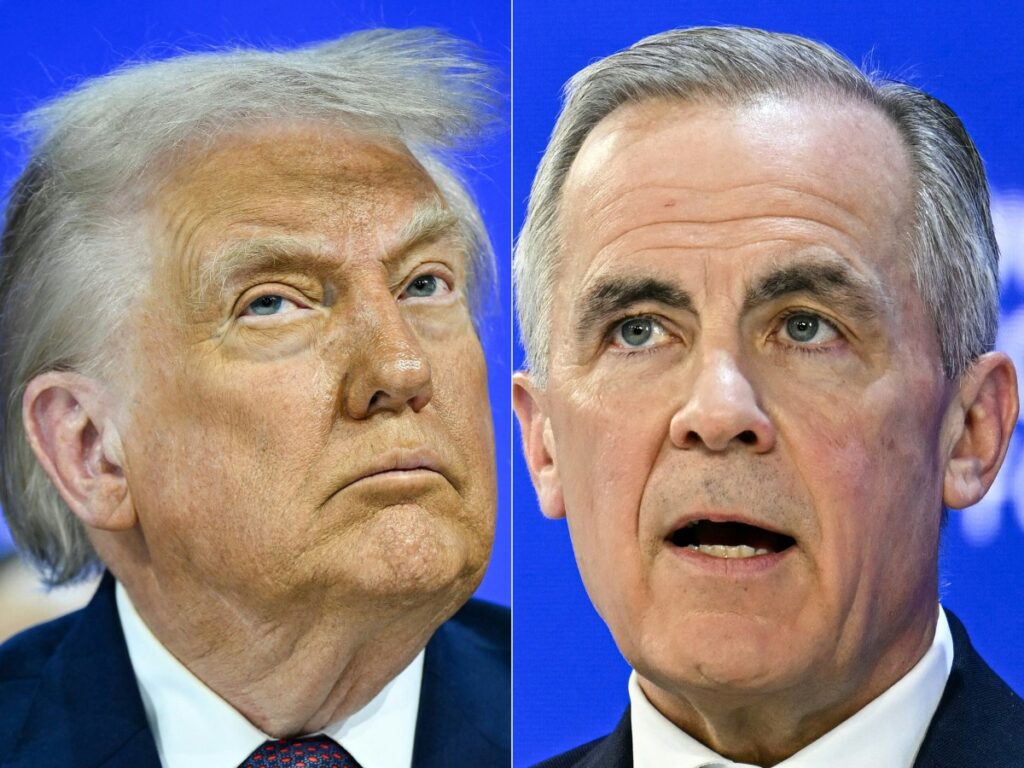
WASHINGTON — Former U.S. President Donald Trump issued a stark warning to Canada on Saturday, threatening to impose 100% tariffs on all Canadian imports if the nation proceeds with a trade agreement with China. The declaration, made via his Truth Social platform, escalates already tense relations between the two North American neighbors.
Trump’s comments directly targeted Canadian Prime Minister Mark Carney, whom he mockingly referred to as ‘Governor’—a derogatory reference to his persistent suggestion that Canada should become the 51st U.S. state. ‘If Carney thinks he is going to make Canada a ‘Drop Off Port’ for China to send goods and products into the United States, he is sorely mistaken,’ Trump wrote. He further claimed that China would ‘eat Canada alive, completely devour it, including the destruction of their businesses, social fabric, and general way of life.’
The threat comes in response to Carney’s recent visit to Beijing, where he celebrated a ‘new strategic partnership’ with China resulting in a preliminary trade agreement aimed at reducing tariffs. This development has been viewed as a significant shift in Canada’s trade policy amid deteriorating relations with the United States since Trump’s return to the White House a year ago.
The diplomatic friction intensified recently when Carney, speaking at the World Economic Forum in Davos, received a standing ovation for his candid critique of a ‘rupture’ in the U.S.-led global order—a remark widely interpreted as a veiled criticism of Trump’s disruptive foreign policy. In retaliation, Trump rescinded an invitation for Carney to join his ‘Board of Peace,’ an initiative initially conceived to address postwar Gaza but now apparently expanding into a broader international conflict resolution body that some observers fear could rival the United Nations.
Canada’s economy remains heavily dependent on trade with the United States, which receives over 75% of Canadian exports. Key industries such as automotive, aluminum, and steel have already been impacted by Trump’s global sectoral tariffs, though these effects have been somewhat mitigated by continued adherence to the existing North American free trade agreement. With negotiations to revise this agreement scheduled for early this year, Trump’s latest threats introduce renewed uncertainty for Canada’s trade-dependent economy.
Prime Minister Carney responded to Trump’s provocations by asserting Canada’s independent identity: ‘Canada doesn’t live because of the United States. Canada thrives because we are Canadian.’ However, he acknowledged the ‘remarkable partnership’ between the two nations, highlighting the complex interdependence that defines their relationship.