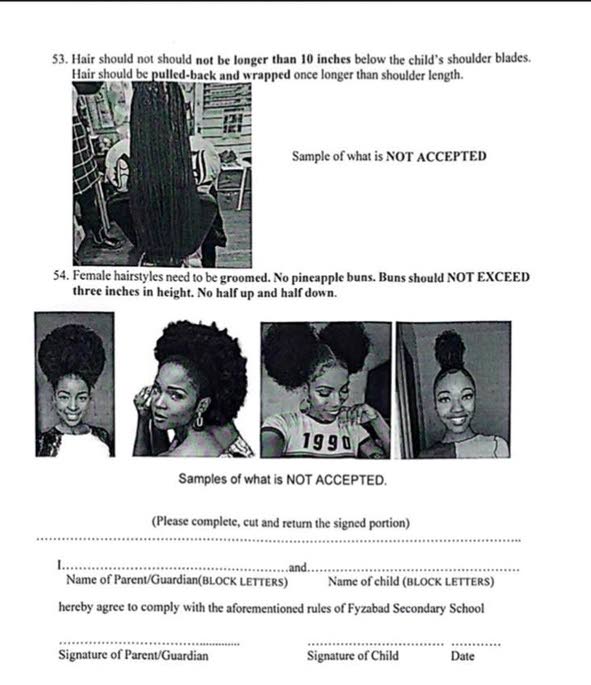
A social media post exposing Fyzabad Secondary School’s hairstyle contract has ignited renewed debates about racial discrimination in Trinidad’s educational system. The document, circulated on January 17th, featured photographs exclusively depicting black women to illustrate ‘unacceptable’ hairstyles, prompting accusations of systemic bias in the multicultural nation.
The controversial contract, requiring parental and student signatures, specified stringent grooming regulations under items 53 and 54 of the school’s 2026 rules. These provisions mandated that hair must not extend beyond ten inches below shoulder blades, prohibited pineapple buns exceeding three inches in height, and banned half-up, half-down styles. Accompanying visual examples solely featured black women sporting afros, braids, and other natural hairstyles, conspicuously excluding representations of Indian women despite Trinidad’s diverse demographic landscape.
Social media commentary rapidly highlighted this omission, with users questioning why Indian hairstyles weren’t represented given their prevalence in Trinidadian society. The controversy intensified when an audio recording surfaced purportedly capturing the school principal threatening three-day suspensions for non-compliant students while defending against racial discrimination allegations.
This incident echoes the 2023 Trinity College Maraval graduation controversy where 23 students were barred from crossing the stage due to hairstyle violations. That earlier incident prompted the Education Ministry to establish a National School Hair Code on July 6, 2023, which explicitly permitted locs, twists, plaits, afros, and cornrows while requiring individual schools to develop specific policies by October.
In a January 19, 2025 statement, the Education Ministry clarified that the national code “does not prescribe or prohibit specific hairstyles,” instead emphasizing that school-level guidelines must be “reasonable, non-discriminatory, [and] respectful of students’ dignity.” Education Minister Dr. Michael Dowlath asserted that grooming guidelines must never “deny a child their right to education.”
The Trinidad and Tobago Unified Teachers’ Association (TTUTA) president Crystal Ashe has urged ministerial intervention, stating that “responsibility for the current confusion rests primarily with the Ministry of Education” due to insufficiently clear national standards. Meanwhile, National Council Parent Teacher Associations president Walter Stewart warned against leaving hairstyle regulations to “subjective” principal interpretations, advocating for inclusive policy development involving cultural and religious groups.