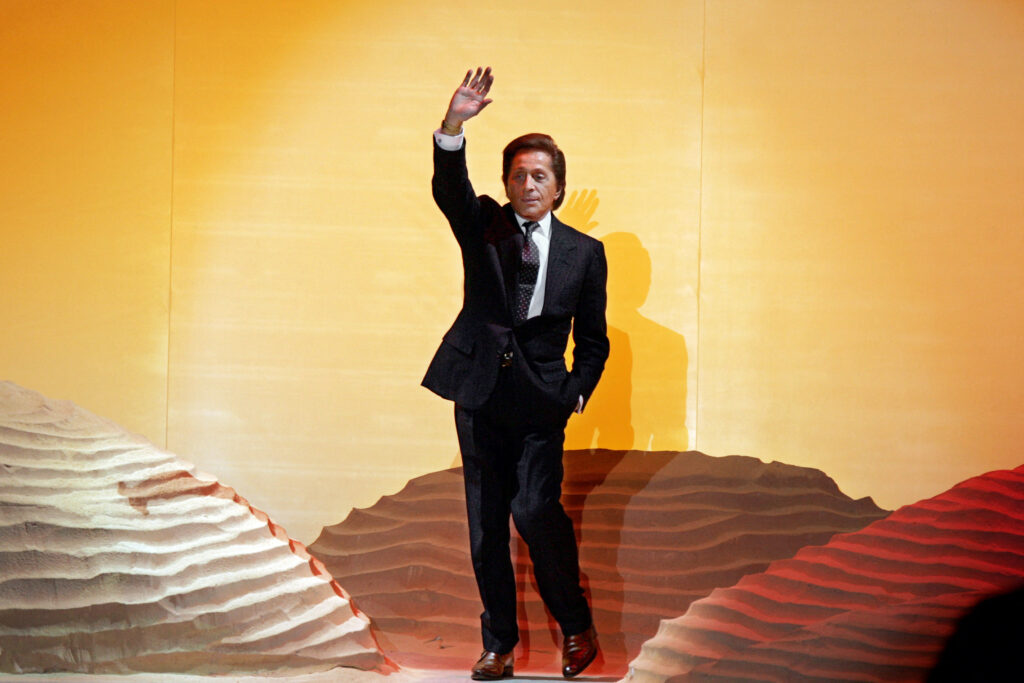
ROME — The fashion world mourns the passing of Italian design maestro Valentino Garavani, who died Monday at 93 in his Roman residence surrounded by close companions. His foundation confirmed the news through social media channels, announcing funeral arrangements scheduled for Friday in the Italian capital with public viewings preceding the service.
Known mononymously as Valentino, the visionary designer spent nearly five decades defining luxury aesthetics for generations of style icons. His signature ‘Valentino red’ creations became sartorial symbols for international aristocracy and Hollywood royalty alike—from Jacqueline Kennedy and Princess Diana to Elizabeth Taylor and contemporary stars like Julia Roberts.
Born May 11, 1932, in Voghera, Lombardy, Valentino developed an early obsession with refined aesthetics. “I have had this illness since childhood,” he told Elle Italia in 2007. “I only like beautiful things.” His journey began at 17 when he departed for Paris to study fashion, immersing himself in the transformative post-war elegance of Christian Dior’s revolutionary designs.
After apprenticeships with Jean Dessès and Guy Laroche, Valentino established his eponymous maison in 1960’s Rome—a city then thriving as ‘Hollywood on the Tiber.’ His 1962 Florence debut collection introduced the world to his now-iconic crimson hue, but his 1964 encounter with Jacqueline Kennedy proved transformative. The future First Lady’s choice of his ivory lace gown for her marriage to Aristotle Onassis catapulted Italian design onto the global stage.
Business partner and former lover Giancarlo Giammetti played a pivotal role in scaling the brand internationally, recalling in the 2008 documentary ‘Valentino: The Last Emperor’ that managing the designer’s genius “required a lot of patience.” Their collaboration built a fashion empire spanning Roman palazzos, Swiss chalets, and a 50-meter yacht—all reflecting Valentino’s philosophy of uncompromising glamour.
The designer’s retirement in January 2008 after his final Paris show marked the end of an era celebrated for sensual, figure-enhancing designs. “I love a woman who eats food, who has a body,” he told The New Yorker in 2005, rejecting extreme thinness in favor of voluptuous femininity. His legacy continues through the Valentino Garavani Virtual Museum—the fashion industry’s first digital museum launched in 2011—ensuring future generations can experience his pursuit of beauty through immersive technology.