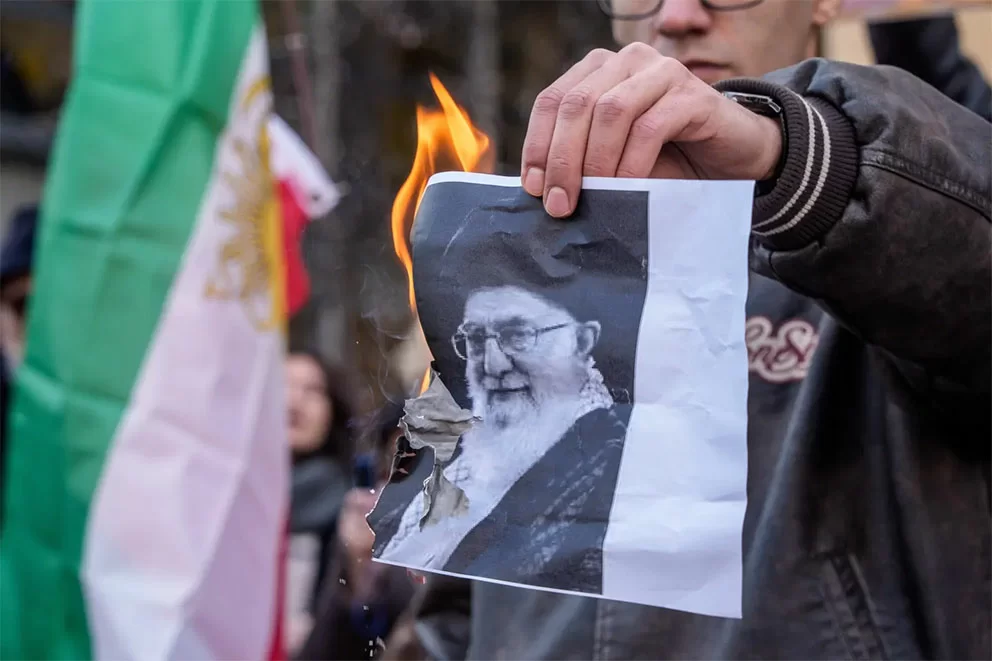
Iran has been engulfed by nationwide demonstrations for two weeks, with protests initially sparked by economic grievances rapidly escalating into violent anti-regime confrontations. The unrest, marked by significant casualties and widespread arrests, represents one of the most substantial challenges to Iran’s theocratic government in recent years.
The protests originated in late December among Tehran merchants before spreading across all 31 provinces. What began as demonstrations against economic deterioration—including currency collapse and soaring prices—quickly transformed into broader opposition against the regime itself. Protesters have been documented burning images of Supreme Leader Ayatollah Ali Khamenei, while some have expressed support for exiled Crown Prince Reza Pahlavi.
Iran’s economic crisis has been exacerbated by multiple factors. Since the reimposition of UN sanctions in September due to Iran’s nuclear program, the Iranian rial has entered freefall, currently trading at over 1.4 million to the US dollar. This economic pressure was compounded by a twelve-day war in June involving Israeli offensives and US airstrikes on nuclear sites. Recent price hikes for subsidized gasoline—previously among the world’s cheapest fuels—and anticipated food price increases following the central bank’s elimination of preferential exchange rates for most goods have further inflamed public anger.
The government response has been characterized by severe measures. Authorities have shut down communication and internet networks, making independent verification of events challenging. According to the Human Rights Activists News Agency, the protests have resulted in over 544 fatalities and approximately 10,600 arrests.
Geopolitically, Iran’s regional influence has suffered significant setbacks. The ‘Axis of Resistance’—Tehran’s coalition of allied countries and militias—has been weakened by conflicts throughout the region. Israel decimated Hamas in the Gaza war, Hezbollah lost leadership figures, and Syria’s President Bashar al-Assad fell in December 2024 after years of conflict. Iran-backed Houthi rebels in Yemen have also been heavily targeted by Israeli and American airstrikes.
International reactions have added complexity to the situation. President Trump warned that the US would respond ‘very hard’ if the regime violently suppresses peaceful demonstrators—a warning given additional context following the capture of Venezuelan leader Nicolás Maduro, a Tehran ally. Meanwhile, China remains a significant purchaser of Iranian oil but provides no overt military support, similar to Russia, which utilizes Iranian drones in the Ukraine conflict but offers limited other assistance.
The nuclear dimension continues to loom large. While Iran maintains its nuclear program is peaceful, increased uranium enrichment and reduced cooperation with the UN’s International Atomic Energy Agency (IAEA) have raised suspicions. The IAEA director warns that Iran could produce sufficient material for approximately ten nuclear weapons should it decide to militarize its program. US intelligence agencies believe Iran hasn’t yet initiated a nuclear weapons program but is preparing to rapidly build one if desired.
This crisis occurs within the broader context of strained US-Iran relations dating to the 1979 Islamic Revolution, which transformed Iran from a key American ally under Shah Mohammad Reza Pahlavi to a theocratic state under Ayatollah Khomeini. The relationship has oscillated between hostility and diplomacy, highlighted by the 2015 nuclear agreement from which the US unilaterally withdrew in 2018, reigniting regional tensions.
Iran now confronts a multidimensional crisis testing its political stability, regional influence, and international relationships, with developments being closely monitored worldwide.