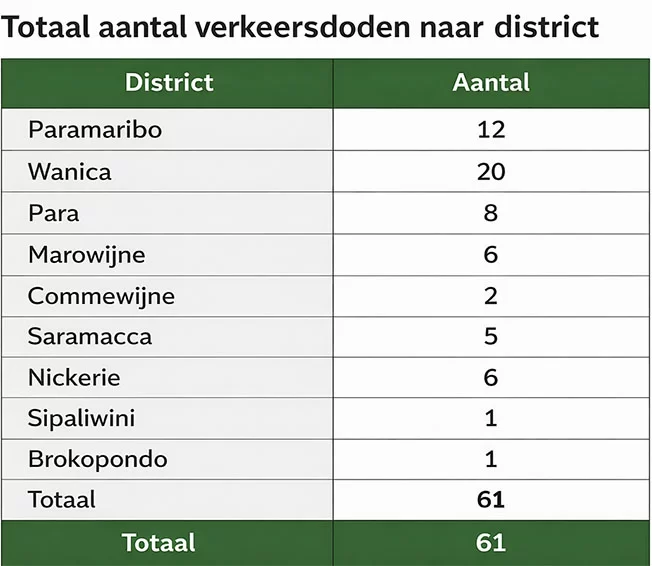
Suriname has witnessed a significant reduction in traffic-related fatalities during 2025, with official statistics revealing a 22% decrease compared to the previous year. According to data released by Purcy Landveld, Deputy Director of the Traffic Safety Institute (VVI), the nation recorded 61 traffic deaths versus 78 in 2024.
Despite this positive trend, road safety remains a critical concern, particularly for vulnerable commuters. Motorcyclists continue to represent the highest-risk demographic, accounting for 19 of the total fatalities. Other casualties included 12 car drivers, 1 bus operator, 3 truck drivers, 6 passengers, 13 pedestrians, 1 cyclist, 4 motorcyclists, 1 ATV rider, and 1 tractor operator.
A disturbing pattern emerged in age distribution, with economically active adults between 21 and 40 years bearing the brunt of fatalities. The 21-30 age group suffered 16 deaths, while 31-40 year-olds accounted for 15 fatalities. Eight young people aged 11-20 also lost their lives in traffic incidents.
Geographical shifts in accident hotspots were noted, with Wanica district reporting the highest fatalities (20), followed by Paramaribo (12) and Para (8). This represents a notable change from 2024, when Paramaribo led with 28 deaths.
The healthcare system continues to shoulder substantial burden from traffic accidents, with the Academic Hospital Paramaribo’s emergency department treating 3,491 traffic victims—averaging 8-9 daily cases. This constant influx strains medical resources, elongates waiting times, and diverts significant healthcare budgets from other critical needs.
In response to 39 fatalities occurring in the first half of 2025, authorities implemented stringent traffic measures including enhanced police surveillance, stricter speed and alcohol controls, and targeted awareness campaigns. These interventions yielded dramatic results, with only 8 deaths recorded in the second half—particularly remarkable during traditionally high-risk holiday periods.
The VVI emphasizes that sustained enforcement combined with improved infrastructure, specialized education for young riders and drivers, and continuous data analysis are essential for maintaining this progress toward safer roads.