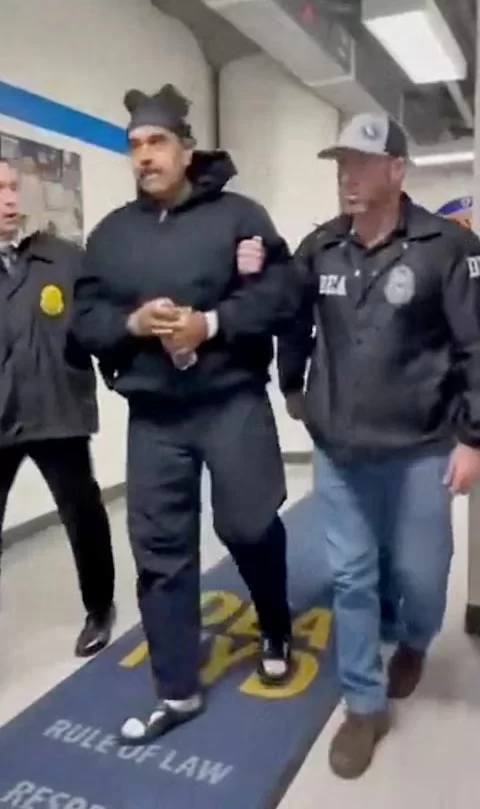
In an unprecedented military operation, former Venezuelan President Nicolás Maduro has been taken into custody at a New York detention facility awaiting trial on narcotics charges. The dramatic arrest, ordered directly by President Donald Trump, represents the most significant U.S. intervention in Latin America since the Panama invasion 37 years ago.
Security footage showed the 63-year-old Maduro, blindfolded and handcuffed, being escorted through DEA headquarters in New York City. Despite his restrained condition, Maduro reportedly wished his captors “Happy New Year” upon arrival. He is scheduled to appear Monday before a federal court in Manhattan.
The operation has triggered international consternation, with many world leaders expressing alarm at the extraordinary capture of a foreign head of state. Memories of recent U.S. interventions in Iraq and Afghanistan have heightened global concerns about the legal and geopolitical implications.
In Venezuela, Maduro’s allies maintain control and have condemned the operation as an “imperialist kidnapping” aimed at seizing the country’s vast oil reserves. The streets of Caracas and other cities remained unusually quiet as citizens grappled with uncertainty, with many choosing to stay indoors amid the tense atmosphere.
President Trump announced that the U.S. would assume temporary governance of the South American nation, which holds the world’s largest proven oil reserves. “We will run the country until we can ensure a safe, correct and wise transition,” Trump stated during a press conference at Mar-a-Lago, praising the operation that extracted Maduro from a secure location.
In a surprising move, Trump dismissed the possibility of opposition leader María Corina Machado assuming presidency, citing insufficient support. This decision disappointed many in the Venezuelan diaspora who had hoped the Nobel laureate would lead a transitional government.
The Venezuelan economy, once among Latin America’s most prosperous, has collapsed under Maduro’s leadership, triggering one of the largest migration crises in modern history. Approximately one-fifth of the population has fled the country.
While many exiled Venezuelans expressed joy at Maduro’s removal, questions emerged about the legality of arresting a foreign leader and the practicalities of U.S. administration. Trump suggested American oil companies would return to rebuild Venezuela’s damaged energy infrastructure, though experts warn this could take years.
The UN Security Council is scheduled to convene Monday to discuss the operation, which Secretary-General António Guterres described as “a dangerous precedent.” Russia and China, both key Venezuelan allies, strongly condemned the U.S. action, with Beijing demanding Maduro’s immediate release.
Pope Francis expressed following events with “a concerned heart” and called for Venezuela to maintain independence while respecting human rights. “The welfare of the beloved Venezuelan people must prevail over any other consideration,” the pontiff stated.
Back in Venezuela, security measures appeared somewhat relaxed despite the nervous atmosphere, with some businesses remaining open and residents continuing Sunday routines. The U.S. lifted Caribbean airspace restrictions that had canceled hundreds of flights following the operation.
The long-term U.S. strategy remains unclear, with Trump’s comments about indefinite military presence echoing rhetoric from previous interventions that ultimately resulted in costly withdrawals after years of occupation.