Trinidad and Tobago witnessed significant developments in wildlife conservation and environmental protection throughout 2025, according to a comprehensive report by the TT Field Naturalists’ Club. The year presented both encouraging advancements and disturbing violations in the nation’s ecological preservation efforts.
Law enforcement agencies conducted coordinated operations in March 2025 across Tabaquite, Rio Claro, and Guayaguayare districts to combat illegal hunting activities following the close of hunting season. The multi-agency operation involving the Praedial Larceny Squad, game wardens, and EMBD state patrol uncovered an illegal teak logging operation in Charuma. Subsequently, authorities charged an individual in Whiteland for illegally hunting protected species including a lappe and iguana.
The legal landscape regarding wildlife possession saw clarification when a Brasso Village nature park failed to convince courts that the 2021 seizure of a red howler monkey was unlawful. This ruling established that merely submitting a possession request to the Wildlife Section does not constitute legal permission to keep protected species.
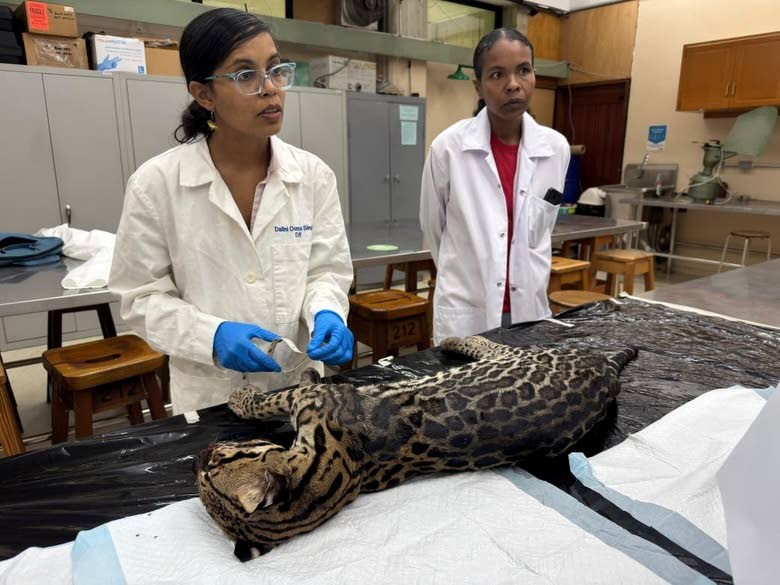
Tragically, December 2025 marked the discovery of a fatally shot ocelot in Grande Riviere, reported by conservationist Len Peters. Veterinary experts at the University of the West Indies’ Zoology Museum conducted a necropsy confirming the animal had been shot, extracting eight shotgun slugs. As Trinidad’s only native wild cat species designated as Environmentally Sensitive since 2013, harming ocelots carries penalties of $100,000 fines and two-year imprisonment.
Marine environments faced parallel challenges, with a distressed whale shark bearing visible injuries found dead near Chaquacabana hotel after being spotted at Peake Yacht Services marina. Meanwhile, proposed development of a 200-room hotel complex at Tobago’s Rocky Point threatened coral reefs serving as nesting sites for protected sea turtles and habitat for endangered elkhorn corals.
Positive developments emerged through judicial and policy channels. The High Court overturned the Environmental Management Authority’s 2018 approval of a massive housing project near St Augustine Nurseries, citing insufficient environmental impact assessment. Justice Robin Mohammed emphasized the EMA’s failure to obtain crucial information regarding micro-climate impacts and agricultural concerns.
July 2025 brought multiple policy advancements including Trinidad’s commitment to the Ocean Coordination Mechanism, International Coral Reef Initiative, 2030 National Biodiversity Targets, and a new National Climate Change Policy. December introduced fireworks regulations prohibiting usage within half-mile radius of forest reserves, national parks, zoos, and animal shelters.
The Solid Waste Management Company’s proposed engineered landfill at Forres Park generated mixed reactions, promising modern waste management while raising community concerns about localized pollution.
Educational initiatives flourished with the publication of the Field Guide of Selected Native and Exotic Medicinal and Edible Plants, while the 2025 Bioblitz event in Maracas documented over 1,000 species through collaboration between the TT Field Naturalists’ Club and University of the West Indies, supported by First Citizens funding.