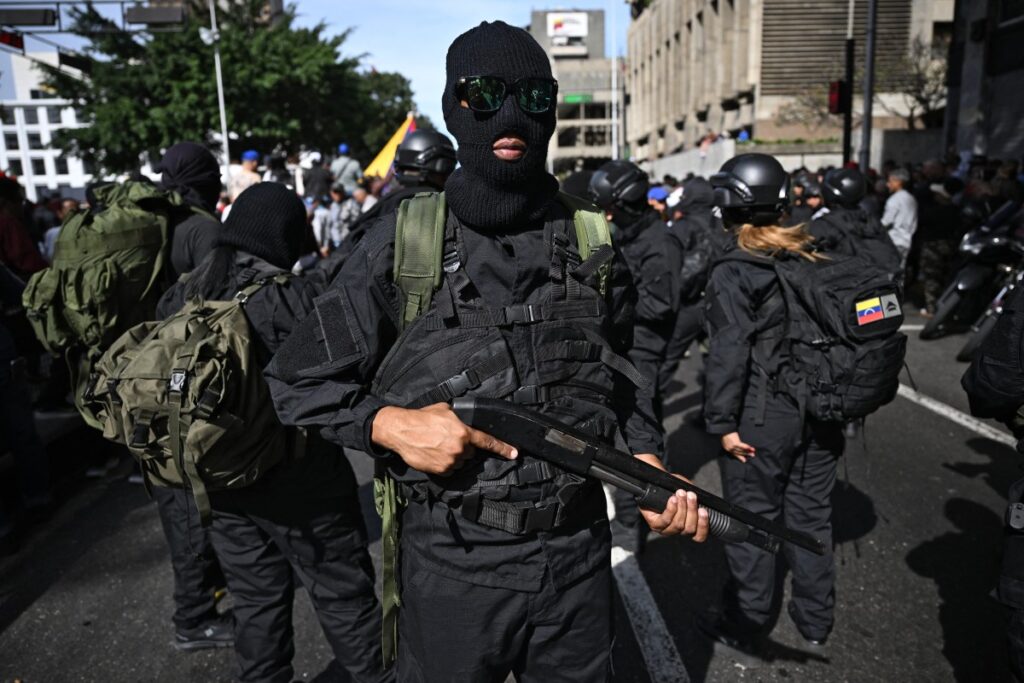
CARACAS, Venezuela — In a dramatic escalation of long-standing tensions, United States military forces executed a series of airstrikes across multiple locations in Venezuela in the early hours of Saturday. The operation, which represents a significant intensification of Washington’s campaign against the left-wing government of Nicolas Maduro, reportedly resulted in the capture and removal of the Venezuelan president from the country.
The military action commenced shortly before 2:00 AM local time (0600 GMT), with residents of the capital Caracas and surrounding regions reporting explosions and aircraft overhead. The strikes continued for approximately seventy-five minutes, with social media footage depicting helicopter sorties and missile impacts creating substantial fireballs and columns of smoke across the night sky.
Former US President Donald Trump announced on his Truth Social platform at 0921 GMT that American forces had ‘successfully carried out a large scale strike against Venezuela’ and confirmed that both Maduro and his wife had been ‘captured and flown out of the Country.’ Several hours after the initial attacks, US Senator Mike Lee corroborated these claims, citing Secretary of State Marco Rubio’s statement that military operations had concluded following Maduro’s apprehension.
Primary targets included Fort Tiuna, Venezuela’s most extensive military complex located in southern Caracas. This strategic installation houses the defense ministry, a military academy, and residential quarters for armed forces personnel. AFP correspondents observed significant flames and smoke emanating from the complex, with visible damage including bullet-marked armored vehicles and trucks at secured entrances. Civilian evacuations were underway as residents fled the area with personal belongings, with one anonymous woman stating she was leaving ‘because they nearly killed us.’
Additional strikes targeted La Carlota airbase east of Caracas, where journalists documented burning armored vehicles and destroyed transportation infrastructure. Explosions were further reported in the port city of La Guaira, the north-central city of Maracay, the Caribbean coastal town of Higuerote, and regions along the Colombian border—a known corridor for narcotics trafficking.
Venezuelan Defense Minister Vladimir Padrino López accused American forces of deliberately targeting residential areas with missiles and rockets, though these allegations remain unverified. Official casualty figures have not been released, with government authorities acknowledging they are still gathering information ‘on the dead and injured.’
The circumstances surrounding Maduro’s capture remain unclear, particularly given the president’s documented practice of frequently changing residences to evade potential capture. Venezuelan Vice President Delcy Rodríguez has demanded that the United States provide ‘proof of life’ for both Maduro and his wife, Cilia Flores. Russia, a key Venezuelan ally, has similarly called for immediate clarification regarding the president’s status.
International reactions have been sharply divided. Russia, Iran, and Cuba—all longstanding partners of Venezuela—condemned the military action as an act of aggression. They were joined in their criticism by left-wing governments in Mexico, Brazil, and Colombia. Russia’s foreign ministry characterized the operation as a ‘deeply concerning’ violation of international norms. The European Union’s top diplomat, Kaja Kallas, urged Washington to exercise restraint and adhere to international law during communications with US Secretary of State Marco Rubio. Notably, Argentina’s right-wing President Javier Milei, a vocal supporter of Donald Trump, emerged as one of the few Latin American leaders to express support for the military intervention.