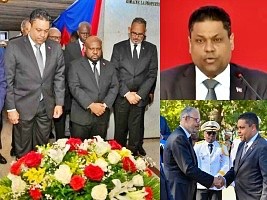
Port-au-Prince, Haiti – January 2, 2026: In a powerful display of national reverence, Haiti’s transitional government leadership gathered at the Museum of the Haitian National Pantheon (MUPANAH) to commemorate Ancestors’ Day, honoring the revolutionary figures who secured the nation’s independence 222 years ago.
Prime Minister Alix Didier Fils-Aimé led the solemn wreath-laying ceremony alongside Laurent Saint-Cyr, President pro tempore and Coordinator of the Transitional Council, accompanied by presidential advisors Smith Augustin, Frinel Joseph, Edgard Leblanc Fils, and Emmanuel Vertilaire. The event drew prominent military and civil officials including Lieutenant General Derby Guerrier, Commander-in-Chief of the Armed Forces, and Vladimir Paraison, Acting Director General of the Haitian National Police.
The ceremony represented more than symbolic remembrance—it served as a reaffirmation of Haiti’s foundational principles of liberty, sovereignty, and historical continuity. In his address, Prime Minister Fils-Aimé characterized the event as “a political act of remembrance” that demonstrates the state’s “unwavering commitment to the cardinal values of liberty, national sovereignty, justice, and human dignity.”
A significant development in this year’s commemoration was the unprecedented recognition of female independence fighters. Laurent Saint-Cyr specifically highlighted women’s contributions to the liberation struggle, marking the first official January 2nd tribute to heroines including Abdaraya Toya (Victoria Montou), Sanite Bélair, Catherine Flon, Suzanne Simone Baptiste Louverture, and Marie-Jeanne Lamartinière. This initiative, championed by Secretary General Marie Élisabeth Régine Joseph Haddad, reflects the administration’s commitment to advancing women’s leadership roles.
The ceremony transitioned to Villa d’Accueil for formal honors, featuring culturally significant performances and photographic exhibitions showcasing emblematic figures of Haiti’s emancipation struggle. Minister of National Education Antoine Augustin provided historical context, detailing the achievements of both celebrated and lesser-known independence heroes.
Against the backdrop of contemporary challenges, the government framed this tribute as both a moral compass and a call to collective action, urging citizens to draw inspiration from their ancestors’ sacrifice for national reconstruction and a more prosperous future.