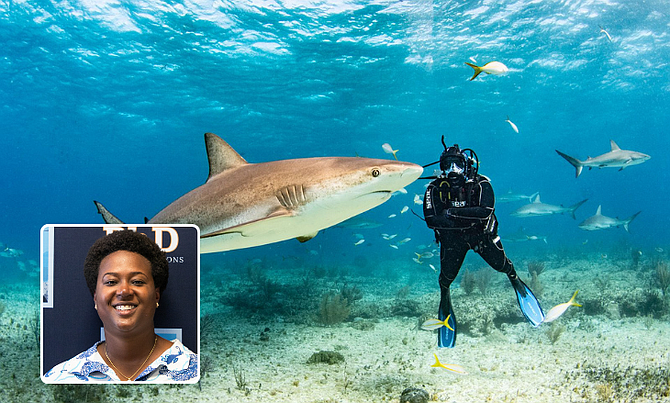
Dr. Candace Fields, a distinguished Bahamian marine scientist, is set to return to her homeland next month following the completion of her doctoral degree in the United States. The 30-year-old researcher will assume leadership of the shark research and conservation program at the Cape Eleuthera Institute, marking a significant advancement in both her professional trajectory and The Bahamas’ prominent position in global marine protection initiatives.
Dr. Fields recently concluded her five-year PhD program in biology at Florida International University, graduating on December 16. Her academic journey, which commenced in fall 2020, faced initial disruptions due to the COVID-19 pandemic, requiring virtual attendance before her relocation to Florida in 2021. During the commencement ceremony, FIU President Jeanette Nunez specifically acknowledged Dr. Fields as an exceptional scholar with international recognition in her field.
Her doctoral dissertation, titled ‘Understanding Shark Sanctuaries as a Conservation Tool: Impacts of the Bahamian Sanctuary on Key Coastal and Pelagic Species,’ conducted comprehensive analysis of The Bahamas’ shark sanctuary effectiveness. The research comprised three pivotal chapters: examining long-term population trends since sanctuary establishment, identifying The Bahamas as critical habitat for endangered oceanic whitetip sharks in the Atlantic, and tracing Hong Kong shark fin markets back to their regions of origin.
Dr. Fields’ appointment represents a homecoming to the institute where her research interests initially developed. She credits her family and advisors for encouraging her pursuit of doctoral studies despite initially planning only a master’s degree. As the first PhD in her immediate family, she emphasizes that academic paths need not be linear, noting her undergraduate degree in neuroscience before returning to her childhood passion for marine science.
Beyond her academic achievements, Dr. Fields has emerged as an international advocate for shark conservation, contributing expert commentary to National Geographic and various conservation platforms. Her work aims to combat widespread misconceptions about sharks, ensuring conservation policies are informed by scientific data while advancing public education about these essential marine predators.