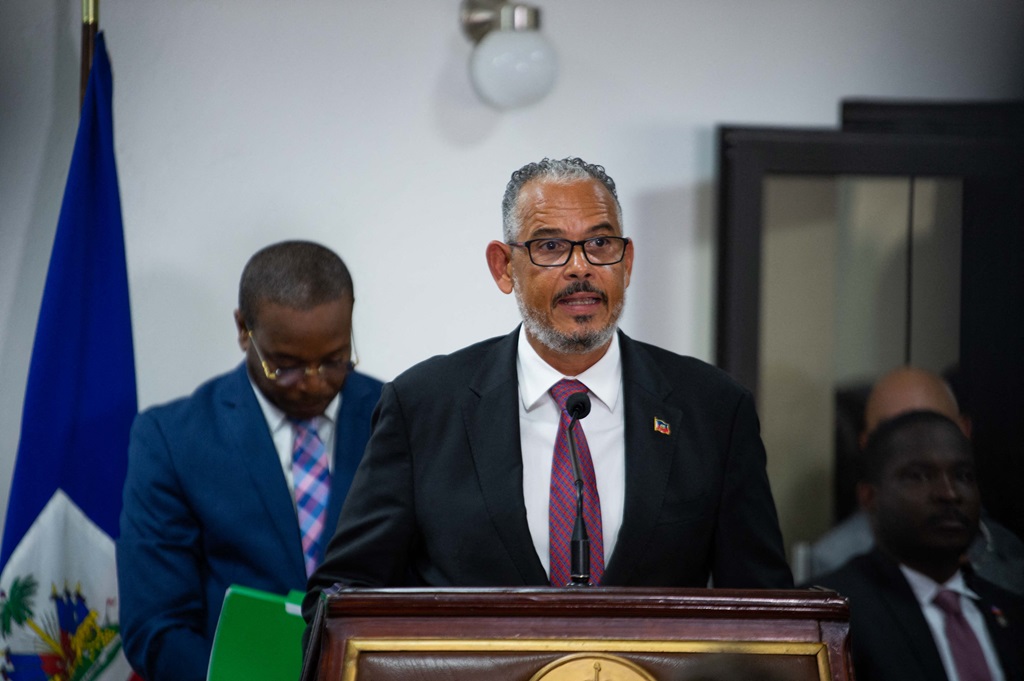
PORT-AU-PRINCE, Haiti – Haitian Prime Minister Alix Didier Fils-Aimé has issued a firm declaration that the provisional government will not engage in negotiations with criminal gangs attempting to overthrow the state. The uncompromising stance came during his Sunday visit to the Haitian National Police (PNH) headquarters in Clercine, a metropolitan area near the airport known for significant gang activity.
Accompanied by Justice Minister Patrick Pélissier, Secretary of State for Public Security Mario Andrésol, and senior police officials, Fils-Aimé emphasized that “the Government’s fight is against gangs. The Government’s fight is to secure the country. The state will not compromise. The state will not negotiate with criminals.”
The visit formed part of a broader mobilization of state security forces, including the PNH, Haitian Armed Forces (FAd’H), and the specialized Gang Suppression Force (FRG), all engaged in a coordinated offensive against armed criminal groups threatening national security.
During the inspection, Fils-Aimé expressed official gratitude to the U.S. State Department’s Bureau of International Narcotics and Law Enforcement Affairs (INL) for donating 25 armored personnel carriers. This strategic equipment is expected to enhance operational capabilities, protect deployed units, and strengthen law enforcement intervention power against criminal elements.
The Prime Minister asserted that this reinforcement would enable security forces to gradually reclaim territories occupied by armed groups and ensure long-term population security. He emphasized that restoring security constitutes a prerequisite for returning to constitutional order, with 2026 targeted for organizing general elections and renewing political institutions.
Haiti continues to grapple with a multidimensional crisis characterized by rampant gang violence, political instability, and humanitarian disaster. Criminal groups have utilized sexual violence as a terror tactic, disrupted food supplies causing widespread hunger, displaced over 362,000 people, and overwhelmed international aid efforts.
United Nations officials maintain that while security measures are necessary, they alone cannot resolve Haiti’s crisis. They emphasize that political solutions, credible elections, and sustained economic support remain crucial for achieving lasting stability.
Outgoing CARICOM Chairman and Jamaican Prime Minister Andrew Holness noted in his year-end message that the 15-member regional bloc has sustained advocacy for increased international support for Haiti. These efforts have kept the crisis on the global agenda and contributed to the UN Security Council resolution establishing the Gang Suppression Force, partially funded by United Nations resources.
“CARICOM is now a key partner in the tripartite coordination of the Organisation of American States’ Roadmap toward Stability and Peace in Haiti, and we look forward with optimism to the preparations for free and fair elections in 2026,” Holness stated.