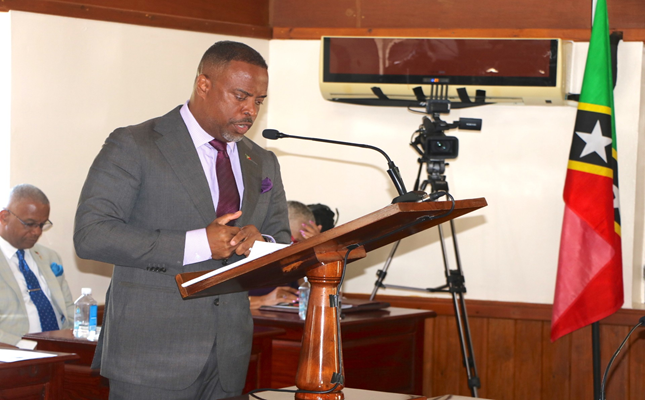
CHARLESTOWN, NEVIS – In a demonstration of cross-party consensus, the Nevis Island Assembly has formally ratified the Nevis Appropriation (2026) Bill, 2025, establishing the financial blueprint for the upcoming fiscal year. The legislative package, which includes accompanying financial resolutions, received unanimous endorsement on December 04, 2025, following extensive deliberations spanning two days.
Premier the Honourable Mark Brantley, who serves as Minister of Finance within the Nevis Island Administration (NIA), initially presented the budget proposal to the Assembly on December 02. The subsequent debate featured substantive contributions from parliamentarians representing both government and opposition factions, ultimately culminating in rare bipartisan approval.
Under the thematic banner “A Purpose Driven Agenda: Building our Sustainable Future,” the approved budget allocates $284.4 million in expenditures against projected revenues of $215.6 million. Premier Brantley characterized the financial plan as embodying his administration’s dedication to responsible governance and meticulous fiscal stewardship, emphasizing its dual purpose of synchronizing government policies with private sector initiatives to catalyze economic expansion.
The Premier provided explicit assurances regarding the administration’s commitment to fiscal prudence, noting that implementation velocity would be directly contingent upon funding availability. “We will not be reckless,” Brantley asserted, “and will only seek to undertake projects if funding is available or accessible at low cost in accordance with our debt management strategy.” He further indicated that projects lacking concessionary financing would be deferred to the 2027 fiscal period rather than pursued through expensive borrowing mechanisms.
The comprehensive budget framework outlines strategic priorities across multiple domains including economic diversification, employment generation, crime reduction, debt consolidation, and infrastructure modernization. Premier Brantley expressed confidence that these interconnected policies would collectively stimulate transformative economic development while empowering citizens to realize their full potential.