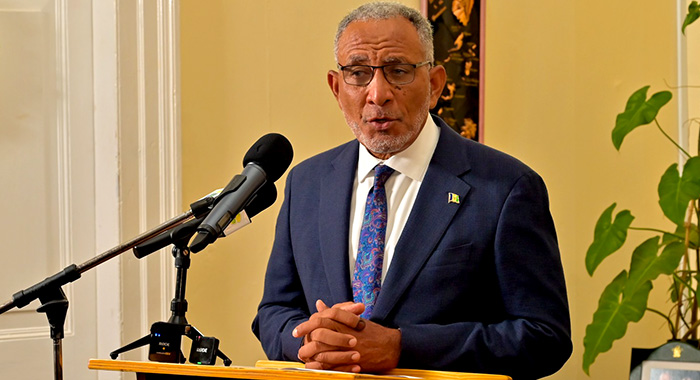
The political landscape of St. Vincent and the Grenadines has been stirred by the conspicuous absence of congratulations from designated Opposition Leader Ralph Gonsalves toward newly elected Prime Minister Godwin Friday. This deliberate omission, rather than undermining the legitimacy of Friday’s administration, has instead become a revealing reflection of Gonsalves’ political posture in the aftermath of a decisive electoral defeat.
Political analysts observe that Gonsalves’ response mirrors allegorical narratives of power dynamics, reminiscent of Orwellian themes where established orders struggle to acknowledge shifting realities. The electoral outcome demonstrated that Vincentian voters exercised independent judgment rather than flocking behavior, decisively rejecting the previous governance model.
Gonsalves characterized his party’s performance as merely ‘a setback,’ a description that many commentators consider strikingly disconnected from the comprehensive nature of the electoral results. This minimization stands in stark contrast to the overwhelming public mandate received by the new administration, suggesting a significant divergence between political leadership and popular sentiment.
The former leader’s recent address contained ominous predictions about the National Democratic Party’s future, delivered with almost prophetic undertones. This is particularly notable given his apparent failure to foresee his own party’s electoral collapse. The irony is compounded by his literary references to Frost, Thomas, and Henley—poetic invocations of resilience that now accompany a diminished political standing.
Vincentian public discourse suggests that Gonsalves’ request for political ‘lifting’ was fulfilled in the most literal sense: while he maintains his position, nearly all of his party’s candidates were dropped by the electorate. This selective elevation speaks volumes about the nuanced will of the people.
The absence of traditional political courtesy, while notable, aligns with Gonsalves’ established pattern of operating outside conventional diplomatic norms. Rather than diminishing the new administration, this behavior invites public assessment of statesmanship qualities and appropriate political conduct in democratic transitions.
Ultimately, the electoral verdict remains unchanged by the lack of ceremonial acknowledgment. The people have spoken through constitutional processes, and the new government proceeds with its mandate undiminished by predecessor’s refusal to recognize its legitimacy.