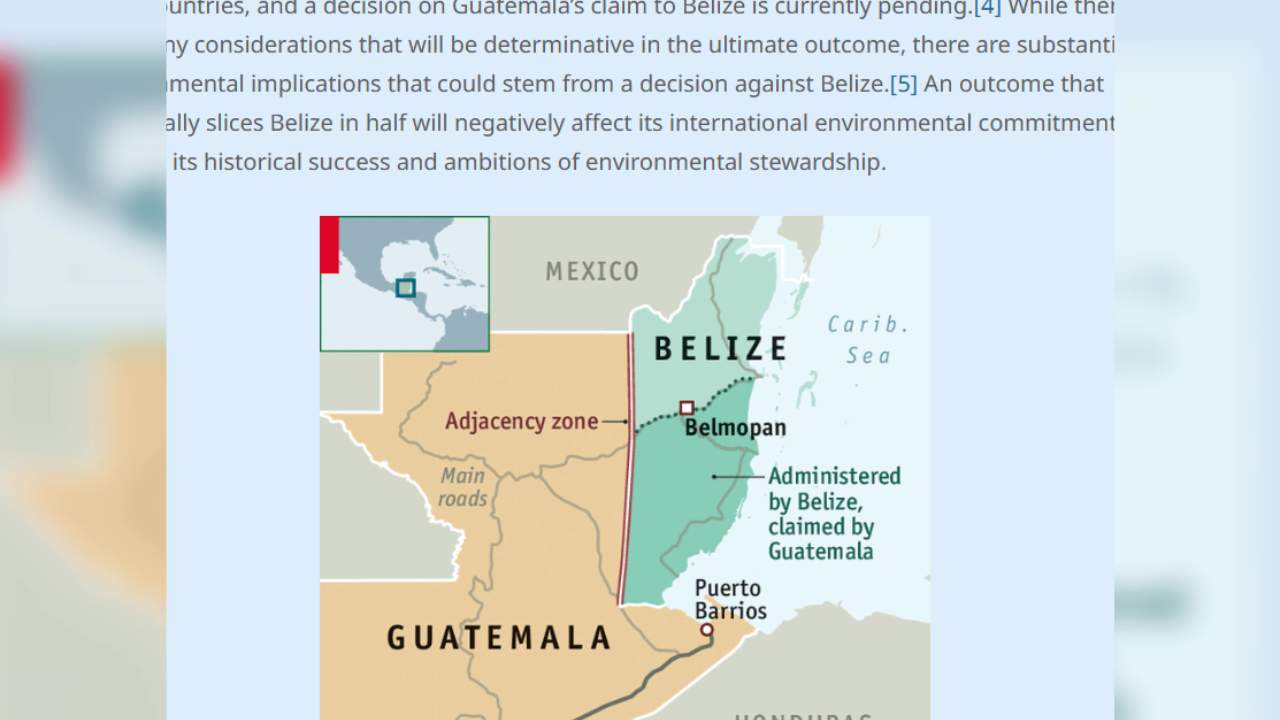
In a recent development, Guatemala has sought to intervene in Belize’s legal case against Honduras concerning the Sapodilla Cayes, asserting that the islands overlap with its own territorial claims. This move reignites a decades-long dispute, despite previous assurances of peaceful resolutions. Beyond the geopolitical implications, Belizean law student Ethan Singh has drawn a compelling connection between sovereignty and environmental stewardship. In a detailed blog post, Singh, a student at Washington College of Law, examined Belize’s adherence to international environmental treaties and its impact on the nation’s territorial integrity. Singh traced Belize’s environmental commitments back to the 1992 United Nations Framework Convention on Climate Change, followed by the 2015 Paris Agreement, and the recent Biodiversity Beyond National Jurisdiction Treaty, which Belize was among the first to endorse. He emphasized the principle of precaution in international environmental law, advocating for proactive measures to prevent environmental degradation. Singh highlighted Belize’s dedication to preserving its forested lands, contrasting sharply with neighboring Guatemala. This commitment, he argued, underscores Belize’s role as a leader in environmental advocacy, particularly for small island nations. As tensions over territorial claims persist, Singh’s analysis offers a fresh perspective on the intersection of environmental policy and national sovereignty.