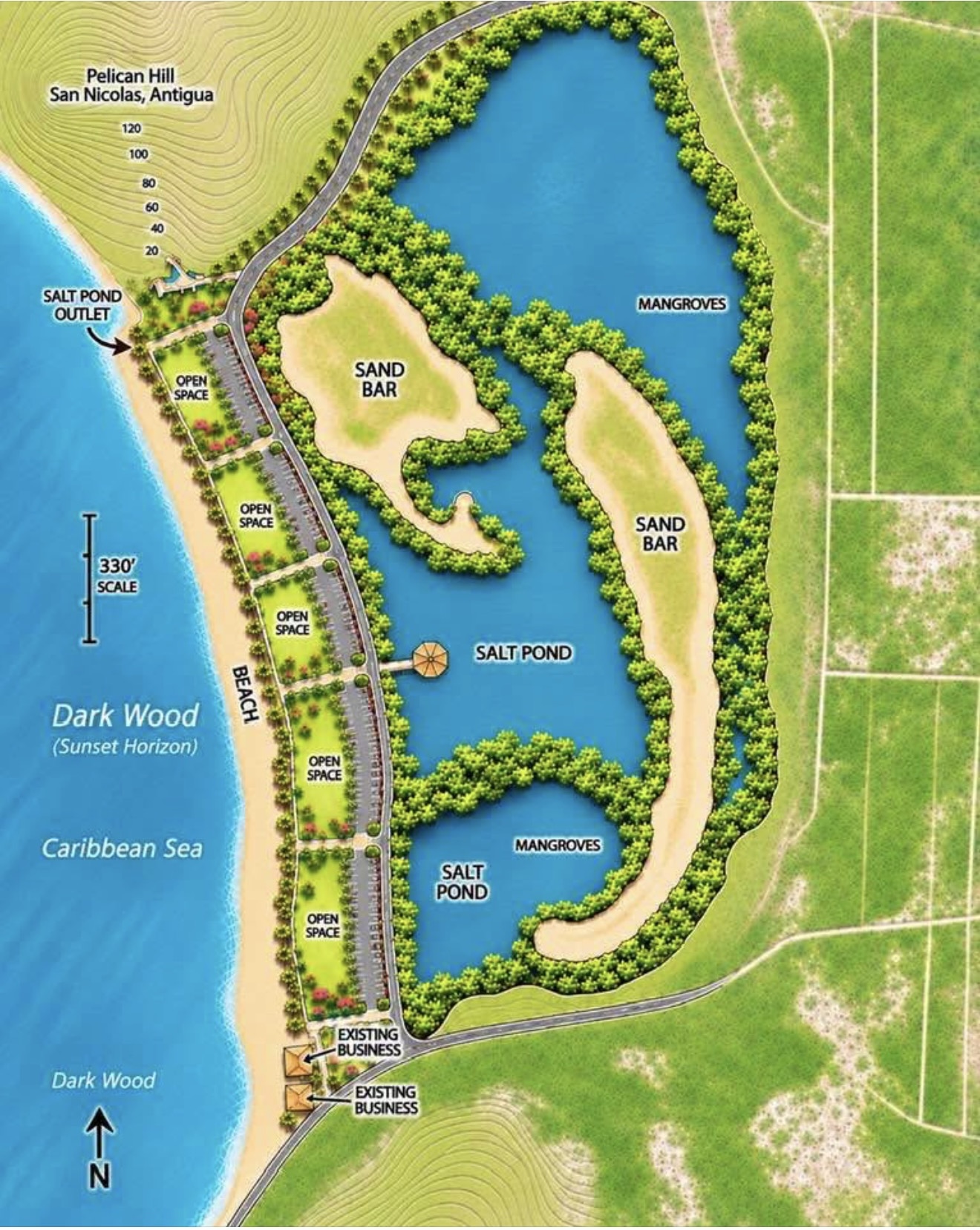
Antigua and Barbuda Prime Minister Gaston Browne has publicly released a draft conceptual design for a new public beach park at Darkwood, kicking off a national government initiative to build fully featured public recreational parks at 11 coastal locations across the twin-island nation.
The Darkwood design, shared by Browne via social media on a Wednesday morning, outlines a landscaped public zone parallel to the shore, with dedicated parking lots, multiple open gathering spaces, and a designated access road that physically separates public amenities from the adjacent sensitive salt pond and mangrove ecosystems. The plan preserves existing commercial operations at the southern edge of the proposed park, retains the natural tidal outlet that connects the salt pond to the Caribbean Sea, and clearly maps the surrounding sandbars, mangrove tracts, and full expanse of the salt pond to safeguard these ecological assets.
This announcement builds on remarks Browne made just days earlier during his *Browne and Browne Show* radio program, where he first laid out the administration’s broader vision to move far beyond the narrow, basic shore access paths that currently exist at many popular beaches. Browne named the full list of 11 targeted locations for the new beach parks: Fort James, Ffryes, Darkwood, Morris Bay, Half Moon Bay, Little Ffryes, Pearns, Jolly Harbour, Palmetto, Princess Diana Beach, and Coco Point.
While the Darkwood concept is presented as a preliminary blueprint, Browne’s public post did not include finalized construction timelines, total projected costs, funding source details, or a formal breakdown of the regulatory approval process for the projects. The policy rollout comes amid surging public debate over longstanding tensions around beach access, as local communities have increasingly raised concerns that private coastal developments are limiting ordinary residents’ ability to enjoy the nation’s public shorelines.
A core non-negotiable standard for all new beach parks, Browne emphasized, is that every access route must be wide enough at minimum to accommodate emergency vehicles including ambulances, to ensure rapid response for medical crises and safety incidents on the coast. He cited ongoing beach access work in Barbuda as the model for this new national standard, noting that developers of adjacent private properties there have already been required to reserve sufficient right-of-way for emergency vehicles and set aside dedicated space for public beach recreational areas.
To steer the rollout, the government has assembled a dedicated interagency committee tasked with auditing all existing beach access points across the country and facilitating collaborative negotiations with private coastal landowners. Browne openly acknowledged that the process requires careful, sensitive handling, as the administration must strike a fair balance between upholding the public’s legal right to beach access, respecting private property ownership rights, and addressing legitimate security concerns raised by hotels and other commercial coastal developments. He stressed that the government will not pursue forced eminent domain actions to seize private land for access routes, and instead will prioritize good-faith negotiations to reach mutually agreeable solutions with property holders.
Planned upgrades for two high-profile sites, Jolly Beach and Pearns Point, will deliver shorter, more direct public routes to the shore, plus permanent amenities including public restrooms, shaded gathering areas, and expanded parking. At Jolly Beach, the current makeshift parking lot and narrow access path are only temporary arrangements put in place during construction of the new Nikki Beach hotel resort; the final permanent layout will move public parking closer to the shore and integrate the full public beach park design.
Browne also confirmed that his administration recently rejected a $100 million investment proposal from cruise giant Royal Caribbean for a development at Fort James, because the company demanded exclusive private control over the public beach – a condition the government rejected outright to preserve universal public access for local residents.
The policy push has been fueled by sustained grassroots public advocacy: on November 19, prominent local beach access activist Eli Fuller delivered a formal petition to Browne calling for legal protection of public access at Jolly Harbour. Despite a heated public exchange between Fuller and Browne immediately after the petition handover, the prime minister confirmed he fully welcomes the community submission, noting that the public mandate demonstrated by the petition will strengthen the government’s negotiating position when engaging private landowners to secure expanded public beach spaces. The Darkwood conceptual design, officials note, is the first tangible public demonstration of how the government intends to move past basic shore access paths and deliver permanent, well-resourced public recreational coastal spaces for all residents and visitors.
PM Browne unveils Darkwood concept as government targets 11 beach parks