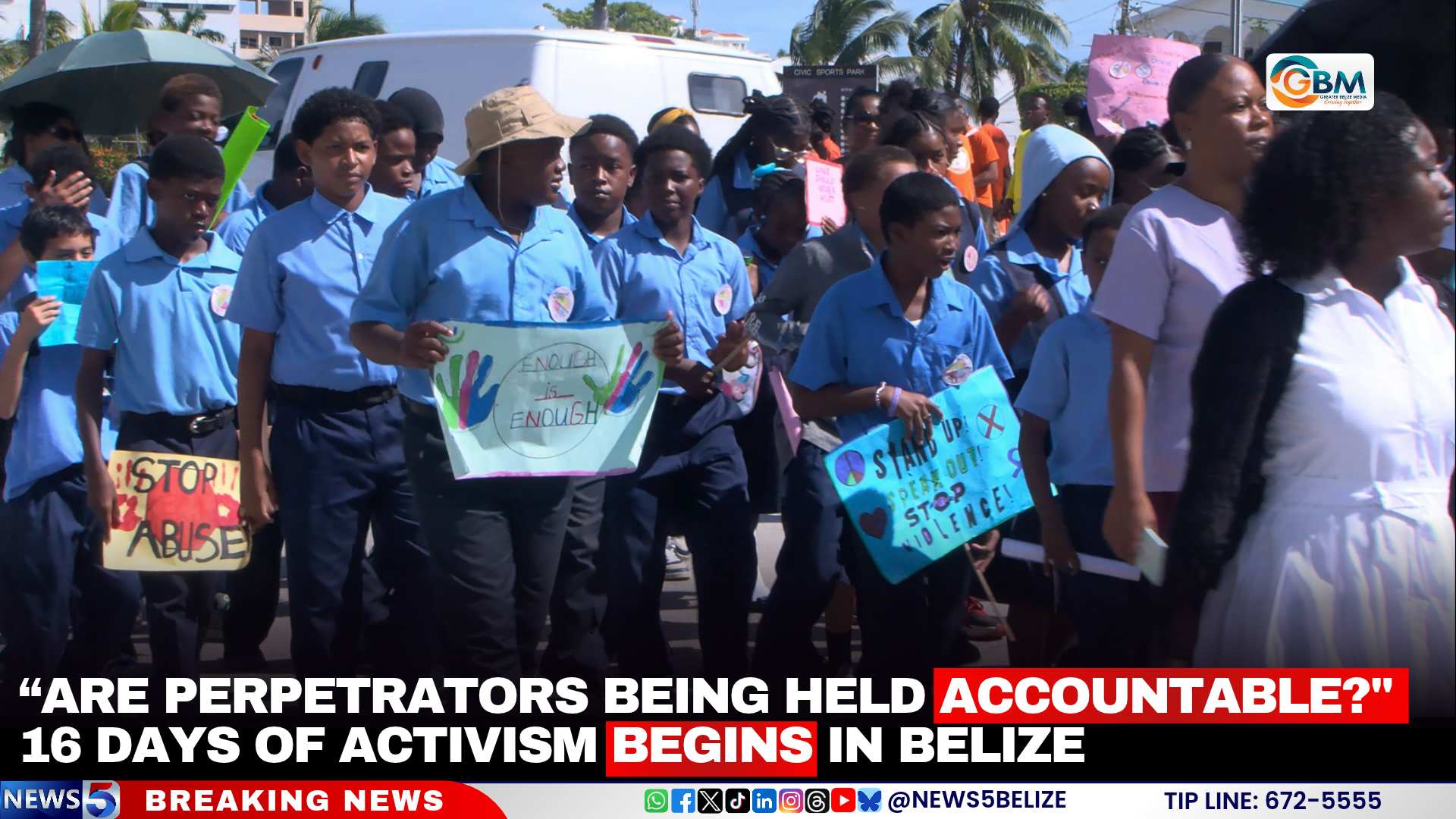
On November 25, 2026, Belize officially launched its globally recognized annual 16 Days of Activism Against Gender-Based Violence campaign, opening with a formal flag-raising ceremony hosted at the Flag Monument roundabout in Belize City, followed by a cross-community solidarity march that concluded at the Belize Civic Center. This year’s 2026 observance operates under the core guiding theme: “Ensure Justice. Protect Survivors. End Impunity”, framing all planned advocacy, policy dialogue and community outreach around holding abusers fully accountable rather than just raising public awareness.
Delivering the keynote address at the launch event, former Belize Family Court Director Margaret Nicholas emphasized that meaningful progress to eradicate gender-based violence cannot rely on superficial gestures alone, and demands coordinated, sustained action across households, local neighborhoods, and all levels of public and private institutions. “We cannot judge the success of this campaign by how many speeches we give, how many banners we hang, or how many events we host,” Nicholas stressed. “The only valid metric for success is tangible, positive change in the daily lives of every man, woman, and child across this country.”
Nicholas specifically highlighted the growing threat of gendered harm moving into digital spaces, noting that cyberbullying and online harassment targeting vulnerable groups have seen sharp, sustained rises in recent months. She praised the passage and implementation of Belize’s dedicated Cyberbullying Legislation as a critical protective milestone, while warning that unaddressed digital forms of abuse often leave survivors with even fewer clear pathways to seek redress than in-person violence.
To ground the campaign’s priorities in measurable outcomes, Nicholas laid out a series of targeted accountability questions for all stakeholders: “We have to keep asking ourselves: Are survivors truly safe in their homes and communities now? Are support services for people fleeing violence easier to access for those in remote districts? Are our public institutions living up to their legal obligations to protect vulnerable people? Are perpetrators facing consistent, fair, effective consequences through our formal legal processes? And are ordinary community members rejecting the long-held cultural normalization of gendered violence?” She went on to urge national policymakers to continue strengthening and refining existing legal and institutional support frameworks, and called on all social service providers to streamline disjointed, fragmented support systems so that survivors do not have to navigate confusing, bureaucratic hurdles at the moments when they are at their most vulnerable and traumatized.
Official data published jointly by the Belize Ministry of Home Affairs and the Belize Crime Observatory paints a mixed picture of recent progress on reducing domestic violence: between April and June 2026, total domestic violence reports dropped 18% compared to the same three-month period in 2025, representing a reduction of 101 total reported cases. Seventy percent of all complainants across the quarter identified as female, 52% of recorded cases resulted in formal court action, while the remaining 48% remained in active investigation at the time of the report. Notably, the Cayo District was the only administrative region to record a rise in domestic violence reports over the period, logging 31 additional cases that marked a 32% year-on-year increase.
Closing her address, Nicholas pushed back against the common public framing of gender-based violence as an exclusively women’s issue. “Preventing this harm is not a niche cause for any single group,” she stated. “It is a fundamental human rights issue, a core family welfare priority, and a shared responsibility for every community and the nation as a whole.”