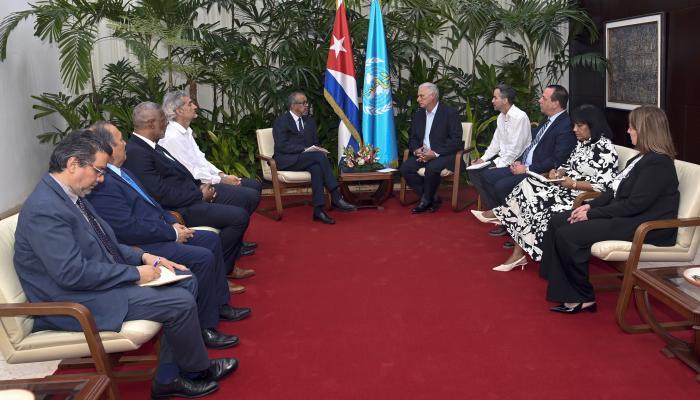
Havana, November 24, 2026 – A high-level bilateral meeting unfolded at Havana’s Palace of the Revolution on Monday afternoon, where Miguel Díaz-Canel Bermúdez, First Secretary of the Central Committee of the Communist Party of Cuba and President of the Republic of Cuba, formally welcomed Dr. Tedros Adhanom Ghebreyesus, Director-General of the World Health Organization, during the latter’s official visit to the Caribbean island nation.
Díaz-Canel opened the discussion by extending explicit gratitude for Tedros’ arrival, emphasizing that the WHO delegation’s visit arrives amid an unprecedentedly turbulent period for Cuban communities, marked by the sharp escalation of the decades-long U.S. economic blockade, a crippling U.S.-imposed energy siege, and a sweeping “maximum pressure” policy that has rippled through every facet of daily life for Cuban households. The Cuban head of state underscored that these punitive measures have inflicted disproportionate harm on the island’s long-established public health infrastructure, a system once widely celebrated across the Global South for its universal access and strong outcomes.
Presenting granular, on-the-ground data to illustrate the cascading damage to care delivery, Díaz-Canel outlined that more than 100,000 Cuban patients are currently stuck on waiting lists for routine, fully feasible surgical procedures, delayed almost entirely by rolling blackouts and widespread shortages of critical medical supplies and prescription medications. A large share of these waitlisted patients are children, he added, while over 34,000 pregnant people across the country are unable to access the full scope of prenatal monitoring and clinical care they require for safe pregnancies.
Nearly 67% of Cuba’s essential basic medication roster is currently unavailable to the public, the president noted, with more than 10,000 oncology patients facing disruptions to their scheduled radiology treatments. Even the country’s world-renowned, decades-old national childhood vaccination program – long a model for other low and middle-income nations – is now operating with outdated equipment, threatening its ability to deliver consistent, timely immunizations. Díaz-Canel confirmed that key public health metrics have already deteriorated as a direct result, including the national infant mortality rate, which had previously held steady at 4 per 1,000 live births but has spiked to 9.9 so far in 2026. He also highlighted the severe strain on renal care services, where patients relying on life-sustaining hemodialysis face frequent gaps in treatment due to power cuts and supply shortages.
Despite these overwhelming hurdles, Díaz-Canel emphasized that Cuban healthcare workers remain unbroken: thousands of doctors, nurses and clinical staff navigate daily blackouts and severe gaps in public transit to report to their posts and deliver care to communities, refusing to let external pressures dismantle the country’s public health mission. He went on to specifically thank Tedros for his March 2026 public statement formally acknowledging the severe harm the U.S. energy siege has inflicted on Cuba’s health system, as well as the WHO’s subsequent mobilization of emergency funding and targeted technical cooperation to mitigate the crisis. Reaffirming Cuba’s ongoing commitments as a WHO member state, Díaz-Canel extended an open invitation for expanded joint collaboration, including shared public health research and Cuban technical support for regional and global health initiatives.
For his part, Tedros warmly recalled his first in-person meeting with Díaz-Canel dating back to April 2018, and thanked the Cuban leader for his time and transparency during the visit. He noted that prior to the formal meeting, he and his delegation had already conducted site visits to Havana’s William Soler Pediatric Hospital and the state-run Center for Genetic Engineering and Biotechnology (CIGB), describing the scientific and clinical progress Cuban teams have achieved despite external constraints as deeply impressive. While acknowledging the very real systemic challenges facing the country, Tedros emphasized that he and his team had gained firsthand, detailed insight into the scope of Cuba’s public health challenges through conversations with senior Ministry of Public Health officials, as well as frontline clinical staff.
Tedros confirmed that the March 2026 WHO statement on Cuba’s health crisis was issued in direct response to the organization’s deep, documented concern over the cascading humanitarian impacts of the blockade and energy siege, and that the decision to roll out targeted emergency support for Cuba was formally agreed on the sidelines of the recent World Health Assembly.
Also in attendance for the Cuban side during the official meeting were José Angel Portal Miranda, Minister of Public Health; Anayansi Rodríguez Camejo, Vice Minister of Foreign Affairs; and Mayda Mauri Pérez, President of the BioCubaFarma Business Group.
Díaz-Canel receives WHO Director-General and denounces impact of the blockade on healthcare