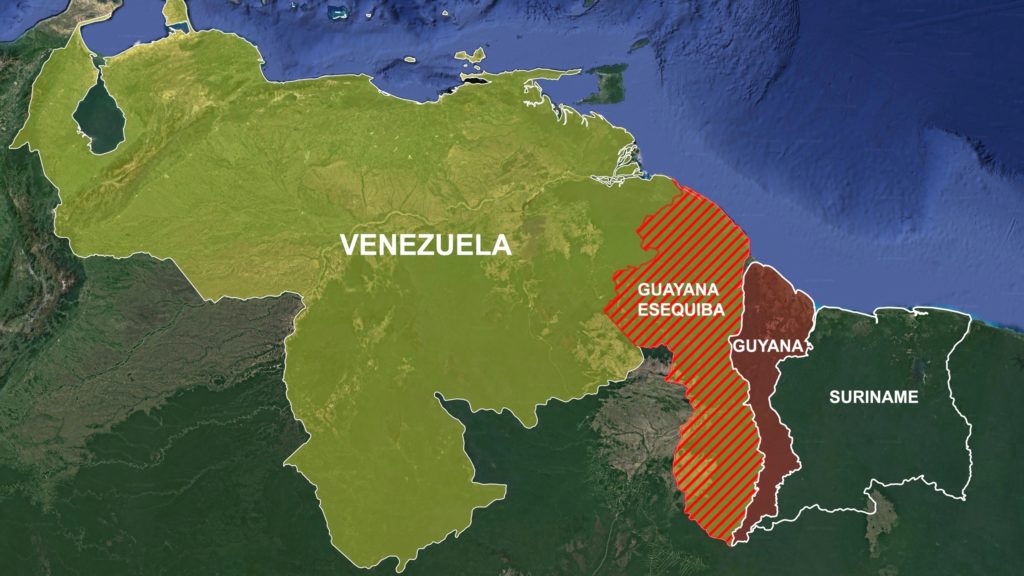
Georgetown’s Ministry of Foreign Affairs and International Cooperation released an official public statement on Thursday to clarify that Washington has formally reaffirmed its longstanding, unadjusted position on Guyana’s decades-old territorial controversy with Venezuela over the resource-rich Essequibo region, dispelling concerns raised by a recent media report detailing a tentative proposal floated by a former senior Trump administration official. The clarification comes one day after a Reuters investigative report, citing three anonymous sources with direct knowledge of closed-door diplomatic talks, revealed that Jeremy Lewin — who served as the U.S. State Department’s director of policy planning under the Trump administration — had raised the unanticipated possibility of Caracas gaining partial administrative control over the Essequibo territory during bilateral discussions with Guyanese representatives in Washington. The report added that Lewin had also extended an offer to facilitate direct territorial negotiations between Guyanese authorities and Delcy Rodriguez, Venezuela’s acting president, with two independent sources confirming the partial control proposal was explicitly raised during those conversations. Lewin later confirmed to Reuters that the preliminary, exploratory discussions with representatives from both Guyana and Venezuela had been fully authorized by the White House, and were initiated in response to a formal May letter Rodriguez sent to U.S. President Donald Trump requesting American mediation of the border dispute. He noted that Rodriguez had also personally brought up the Essequibo conflict during a one-on-one meeting with him in Caracas that July. In its official Thursday statement, Guyana’s foreign ministry confirmed that the matter of these exploratory talks was addressed during a bilateral meeting between Guyanese officials and U.S. State Department representatives in September 2026, where the two sides centered their dialogue on the upcoming ruling from the International Court of Justice (ICJ) over the long-running border claim. The ministry emphasized that U.S. officials had explicitly reaffirmed Washington’s full support for the ongoing ICJ judicial process, a stance that has been consistently communicated across both public announcements and private diplomatic engagements from U.S. government and State Department representatives. “Guyana has received the explicit assurance of the United States Government that nothing has changed in this core position since those discussions,” the statement read. A separate U.S. State Department spokesperson, responding directly to the initial Reuters report, noted that the department routinely reviews a wide range of informal policy proposals from internal and external stakeholders, but that none of these exploratory ideas have altered Washington’s formal, official position on the Guyana-Venezuela boundary dispute. The Essequibo region, which makes up roughly two-thirds of Guyana’s total national territory, has been the subject of a Venezuelan territorial claim stretching back more than 180 years. The long-simmering conflict escalated sharply in 2015, when commercial energy firms uncovered massive, high-value offshore oil reserves in waters adjacent to the region. In response, the Guyanese government formally filed a case with the ICJ in 2018, seeking a binding ruling that upholds the international boundary set by the 1899 arbitral award that granted full sovereignty over Essequibo to Guyana. Georgetown has repeatedly stated that the legal status of the Essequibo territory is non-negotiable and cannot be subject to bilateral bargaining outside of the ICJ process. Most recently, Rodriguez publicly renewed Venezuela’s push for direct negotiations over Essequibo’s legal status during her address to the United Nations General Assembly in September, reigniting global scrutiny over the long-running territorial standoff.