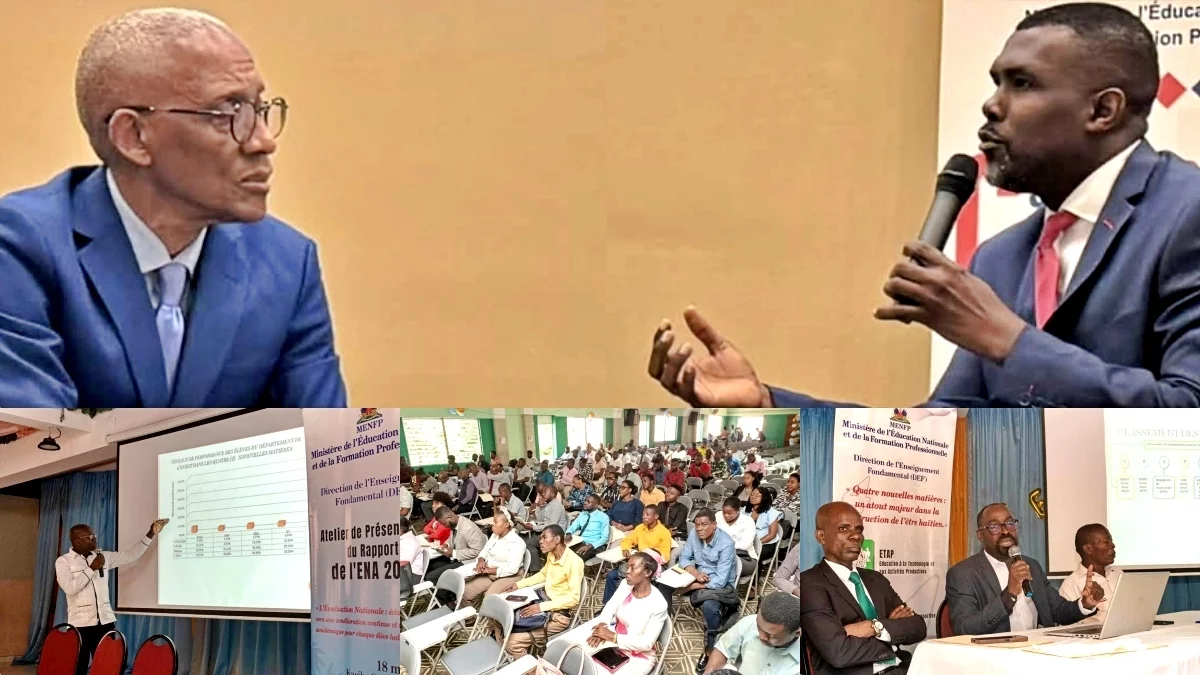
On November 20, 2026, Haiti’s Ministry of National Education wrapped up a two-day sector-wide collaborative workshop, convened in partnership with the Directorate of Basic Education (DEF) and local education development organization Group Croissance, to tackle longstanding gaps in student learning outcomes across the Caribbean nation. Hundreds of on-the-ground education stakeholders, including school principals, lead teachers, district administrators and policy specialists, gathered to analyze both domestic and international student assessment frameworks and co-design actionable solutions to reverse declining academic performance.
Officially opening the high-priority gathering, National Education Minister Vijonet Déméro laid out stark, disquieting findings from the 2025 official 9th Year of Fundamental Education (AF) national exams, which exposed systemic weaknesses in core foundational subjects. Aggregate national pass rates stood at just 65.70% for mathematics, 60.23% for French, and a deeply troubling 50.66% for experimental sciences. Disaggregated regional data for experimental sciences painted an even more dire picture: the North-West department recorded a mere 16.1% pass rate, followed by 24.0% in the South-East, 33.3% in the Centre department, and 33.5% in Artibonite. Minister Déméro emphasized that these underperformance trends threaten to erode the long-term human capital foundation of Haiti’s youth, and demanded immediate, coordinated action across all levels of the national education system.
To address these gaps, the minister formally unveiled a five-point targeted reform roadmap that his administration will roll out in the coming academic year. First, the ministry will roll out a fully transparent, competency-based teacher recruitment system, underpinned by granular, location-specific needs mapping that tracks staffing shortfalls by individual school, subject area, School District Office (BDS) and Departmental Directorate of Education (DDE). Second, pedagogical inspectors will shift their core mandate from punitive oversight to hands-on professional development, increasing regular formative classroom visits to give real-time, tailored guidance to educators. Third, a hybrid continuous professional development program will be deployed, leveraging the national education digital platform to deliver specialized upskilling for 5,000 teachers focused on reading, mathematics and science instruction. Fourth, the ministry will build a unified integrated data system that cross-references assessment results, annual school census data and field observation reports to ensure all policy interventions are evidence-based and their impact is rigorously measured. Fifth, targeted remedial support will be prioritized for early fundamental education grades, including distributing standardized placement tests to BDS and school administrations, launching a mandatory annual Creole literacy and numeracy assessment for 4th year AF students, and introducing a national oral French proficiency evaluation for 6th year AF learners.
Over the workshop’s second day, frontline educators and school administrators led deep-dive sessions to unpack the root causes of persistent poor performance, citing gaps in teacher training, widespread shortages of learning materials, and inconsistent school governance as leading contributing factors. Kesner Pharel, CEO of Group Croissance, led a dedicated session on education data governance, arguing that the full public dissemination of anonymized school performance statistics is a critical, underutilized tool to drive targeted local improvements and accountability across the sector. Participants also mapped out overlapping operational barriers facing core subject instruction, including limited student comprehension of lesson instructions, weak mastery of foundational concepts, inconsistent assessment practices, insufficient allocated learning time, and pervasive shortages of up-to-date teaching resources. Wesly Louis, a senior official from the Directorate of Fundamental Education, presented the full 2025 9th AF exam dataset to attendees to ground all subsequent discussions in verifiable, on-the-ground evidence.