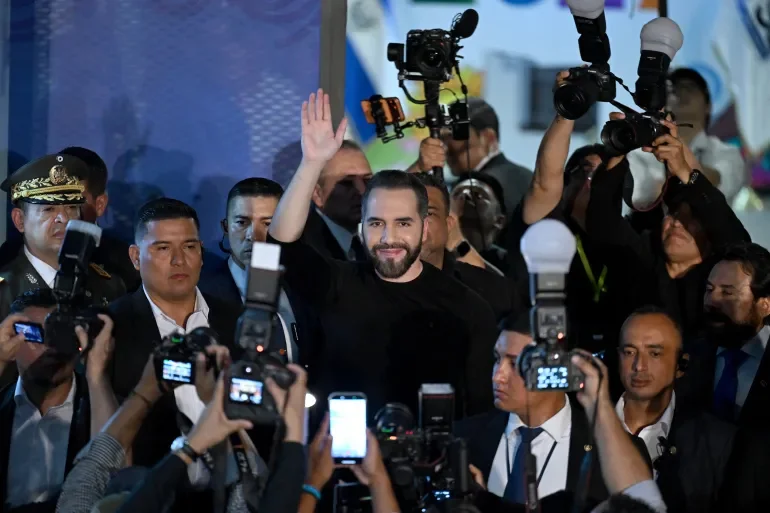
On November 20, El Salvador’s sitting head of state Nayib Bukele formally submitted his bid for a consecutive third presidential term to the country’s Supreme Electoral Tribunal (TSE), flanked by cheering supporters who chanted slogans in support of his re-election as he waved to crowds gathered outside the electoral body. Representing the ruling Nuevas Ideas party, which holds a sweeping parliamentary majority, Bukele will run alongside incumbent Vice President Félix Ulloa on the ticket for the February 28, 2027 general election.
Bukele’s path to extended tenure was cleared in July 2025, when the Salvadoran parliament passed sweeping constitutional amendments that eliminated all presidential term limits, extended the official presidential tenure from five to six years, scrapped the second round of presidential voting, and aligned presidential, legislative, and municipal election cycles. The reforms cut short Bukele’s current term, originally set to run through June 2029, shifting its end date to June 2027; if he wins the upcoming vote, his new six-year term will extend his rule all the way to 2033.
The 45-year-old leader remains the overwhelming frontrunner for the 2027 contest, buoyed by sky-high domestic approval ratings rooted in his administration’s relentless crackdown on transnational criminal gangs. Since a state of emergency was declared in 2022, the government’s mass anti-gang campaign has driven a historic, dramatic drop in national homicide and violent crime rates, a policy that has earned him widespread public support both at home and across parts of Latin America. Yet the security strategy has faced sustained international backlash over widespread arbitrary arrests, documented reports of due process violations, and allegations of systemic human rights abuses against ordinary citizens, including wrongful detentions of people with no gang ties.
Opposition political parties and global human rights groups have roundly condemned the fast-track constitutional reforms, which were passed in a single legislative session with almost no public consultation or extended parliamentary debate. Critics argue the changes concentrate unprecedented executive power in Bukele and his ruling party, systematically erode longstanding democratic checks and balances, and weaken independent oversight of government actions. Human Rights Watch has flagged that the consolidation of executive authority under Bukele is a defining feature of his administration, noting that independent state institutions, journalists, civil society organizers, and political opponents have faced mounting state pressure, with multiple critics either imprisoned or forced into exile in recent years.
Bukele has repeatedly rejected accusations of authoritarianism, framing his administration as a people-centered democratic government that prioritizes citizen safety above all else. While submitting his candidacy, he emphasized that Salvadoran voters have no desire to return to the pre-2022 era when gang violence dominated daily life and made large swathes of the country ungovernable. His administration has also begun exporting its controversial anti-gang security model abroad, deploying roughly 2,500 Salvadoran troops to Haiti last month after four Salvadoran members of a UN-backed international security force went missing. The deployment, which was welcomed by Haitian authorities in Port-au-Prince as local gang violence continues to destabilize most of the Caribbean nation, has boosted Bukele’s international profile, though critics argue he is leveraging foreign security missions to burnish his image as a tough, capable global leader and shore up domestic political support.
With Bukele’s sustained popularity, the ruling party’s legislative dominance, and a fragmented, under-resourced opposition that has little capacity to roll back the 2025 constitutional amendments in the short term, the 2027 electoral landscape heavily favors his re-election. The upcoming February 2027 vote is widely viewed not merely as a routine presidential contest, but a critical referendum on El Salvador’s democratic trajectory, as voters weigh the tangible public safety gains of Bukele’s tenure against growing widespread concerns over eroding institutional guardrails and the prospect of decades-long uninterrupted executive rule.