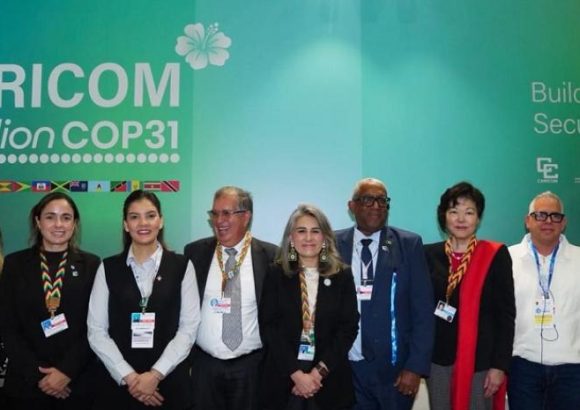
At the 31st UN Climate Change Conference (COP31), the Development Bank of Latin America and the Caribbean (CAF) and the Global Environment Facility (GEF) formally unveiled the SargMarine regional action initiative, backed by a $10 million direct grant from GEF and an additional $67.3 million in planned co-financing, with Mexico and France co-supporting the official launch event. Designed to confront the unprecedented, transboundary sargassum seaweed surge plaguing the Greater Caribbean, the multi-stakeholder project will be implemented by CAF, operated on the ground by the Organization of American States (OAS), and supported with specialized technical expertise from the Inter-American Institute for Global Change Research (IAI).
The core objectives of SargMarine span three interconnected pillars: breaking down information silos across affected nations to enable seamless cross-border knowledge sharing, building unified regional capacity to forecast, track, and proactively manage sargassum landings, and developing scalable, market-viable alternative use cases for the excess seaweed to unlock new income streams for local coastal communities. The launch comes amid rapidly worsening ecological and economic strain: United Nations Environment Program data shows a record 37.5 million tons of sargassum was documented across the Atlantic Ocean in May 2025, the highest volume ever recorded since systematic monitoring began in 2011. Uncontrolled massive accumulations of the floating brown algae have inflicted cascading harm on fragile marine and coastal ecosystems, collapsed peak-season tourism revenues, disrupted small-scale commercial fishing operations, and created public health risks for coastal resident populations across the region.
Speaking at the launch ceremony, Lina Mondragón, CAF’s Climate Action and Positive Biodiversity Manager, emphasized the structural flaw in current national-only responses: “Sargassum is an inherently transboundary phenomenon, but nearly all of our existing mitigation efforts remain siloed within national borders. To overcome this fragmented, inefficient approach, we need to reinforce existing regional coordination mechanisms, fully leverage the institutional capacities of regional intergovernmental bodies, and negotiate binding, collaborative frameworks that turn disjointed national actions into coordinated, high-impact joint operations.”
GEF’s Conventions and Funds Division Manager Chizuru Aoki confirmed the initiative has secured all final regulatory approvals, clearing the path for immediate on-the-ground deployment: “SargMarine is no longer a planning document — we are fully prepared to roll out targeted, tangible actions in affected coastal communities starting immediately.”
Multiple government representatives from sargassum-impacted Caribbean nations echoed the urgent call for cross-border collaboration during the COP31 event. Colombia’s Minister of Environment and Sustainable Development Fabio Arjona Hincapié stressed that isolated local interventions can never resolve a regional-scale crisis, noting that nations must align on joint response protocols and strengthen collective regional negotiating power to address the root drivers of the sargassum bloom. Jamaica’s Special Envoy for Climate Change, Environment, Oceans, and the Blue Economy Matthew Samuda identified real-time monitoring and accurate forecasting as Jamaica’s top national priority, explaining that precise arrival timing and location data will allow authorities to strategically deploy coastal protection resources and plan cost-effective, efficient sargassum harvesting operations. The Dominican Republic’s Vice Minister of Climate Change and Sustainability Ana Emilia Pimentel emphasized that community voices and grassroots needs must be centered in all response design, alongside formal economic impact assessments, to ensure interventions deliver tangible benefits to the populations most directly affected. Panama’s Ambassador to Turkey Karina Arias added that SargMarine’s core design intentionally links national operational capacities, peer-reviewed scientific data, and targeted public and private investment, bringing governments, implementing agencies, the research community, and private sector stakeholders into a coordinated ecosystem that prevents scattered, short-term efforts from going to waste, while prioritizing early warning systems, coastal ecosystem restoration, and circular economy models that turn excess sargassum into a sustainable, community-owned economic opportunity.