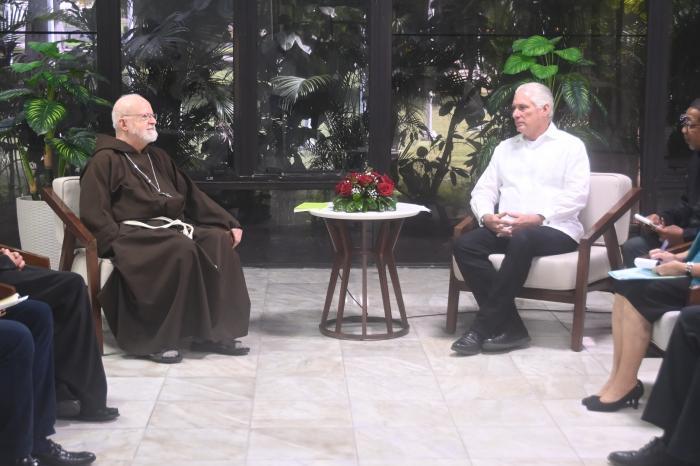
Havana, November 16, 2026 — Top Cuban leader Miguel Díaz-Canel Bermúdez, First Secretary of the Central Committee of the Communist Party of Cuba and President of the Republic of Cuba, formally received a visiting U.S. ecclesiastical delegation at Havana’s Convention Palace at midday Saturday, in a high-profile engagement that underscores longstanding respectful bilateral ties between the Cuban government and the Catholic Church. The delegation is headed by Cardinal Sean Patrick O’Malley, representing the United States Conference of Catholic Bishops. The closed-door discussion covered a wide range of topical issues, including current domestic developments in both Cuba and the United States, as well as pressing shared global geopolitical and social challenges. During the meeting, President Díaz-Canel extended explicit gratitude to the Catholic Church and its affiliated charitable entities for their consistent work streamlining cross-border humanitarian aid deliveries to Cuba from partner nations around the world, a contribution that has supported vulnerable communities across the Caribbean island for years. The U.S. delegation roster includes Archbishop Borys Gudziak, who leads the Conference’s Justice and Peace Commission, Christopher Ljungquist, Director of the Conference’s International Justice and Peace Office, and Mario Jesús Paredes, Executive President of U.S.-based medical non-profit SOMOS Community Care. Also in attendance was Monsignor Juan Gabriel Díaz Ruíz, the newly appointed Archbishop of Santiago de Cuba. Senior Cuban officials joining the president for the talks were Caridad Diego Bello, a member of the Communist Party Central Committee and head of the national Office of Attention to Religious Affairs, and Carlos Fernández de Cossío, Deputy Head of the Cuban Ministry of Foreign Affairs. Official photos of the courtesy meeting were captured by state photography agency Estudio Revolución, marking the latest high-level exchange between Cuban authorities and U.S. religious leadership focused on people-to-people collaboration and humanitarian coordination.