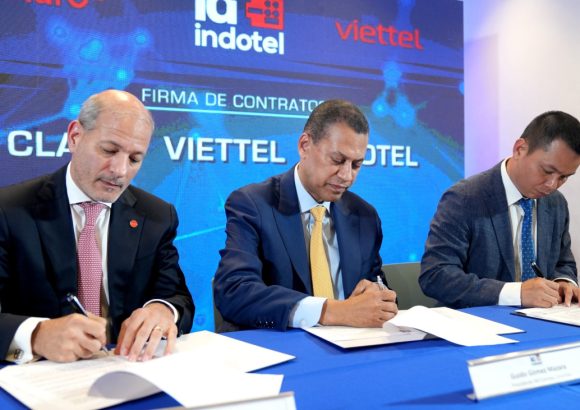
Santo Domingo, Dominican Republic – The Dominican Telecommunications Institute (Indotel) has officially executed formal concession agreements with two telecom operators, incumbent market player Claro Dominicana and new international entrant Viettel Dominicana, marking the successful conclusion of a spectrum allocation process that distributes a total of 260 MHz of valuable radio frequency bands across the country. The landmark deal is projected to spur healthier market competition, draw hundreds of millions in targeted private investment, and close long-standing connectivity gaps for underserved communities across the Dominican Republic.
The combined total of financial commitments tied to the new spectrum concessions reaches US$119.5 million. For Claro, which has maintained active operations in the Dominican telecom market for years, the newly awarded spectrum will be integrated into its existing operating license via a formal addendum, with the company committing US$12.5 million for the frequency access. For Vietnamese state-backed telecom giant Viettel, the US$107 million investment marks its formal market entry as a new competitor, the first international operator to break into the Dominican telecom space following two prior spectrum rounds that failed to attract new overseas players.
During the signing ceremony, Claro Dominicana CEO Carlos Cueto emphasized that the Dominican government’s proactive regulatory framework has laid a stable, predictable foundation that encourages long-term, sustained private sector investment in digital infrastructure. Viettel Dominicana CEO Pham Anh Duc outlined the firm’s core operational goal: to roll out robust, high-performance telecommunications and cutting-edge digital services that reach every demographic, from dense urban city centers to remote, historically overlooked rural communities that have long lacked reliable high-speed internet access.
The concession terms include a unique public benefit provision that allows operators to direct up to 30% of their total committed investment funds to citizen-centric development projects, pending formal eligibility review and contractual approval from Indotel. Eligible initiatives under this framework cover a wide range of public good efforts, including vocational scholarships focused on digital transformation skill-building, programs that expand economic opportunities for young people and small productive industry sectors, and targeted expansion of national fiber-optic backbone infrastructure to reduce service costs for end users.
Viettel’s newly awarded portfolio of low-band and mid-band frequencies will enable the operator to build out full-scale 4G LTE and next-generation 5G networks across its planned service territory. Notably, the allocation of prime 700 MHz spectrum, a band known for its exceptional long-range propagation and ability to penetrate building walls, is expected to drive unprecedented wide-area coverage, particularly in sparsely populated rural zones that have previously been excluded from high-speed mobile service.
The 700 MHz band was freed up for telecom use after the Dominican Republic completed its years-long national transition from analog to digital television broadcasting, a multi-phase effort launched in 2010 that required roughly US$22 million in public sector investment. As part of that transition, the government distributed more than 900,000 free digital converter boxes to low-income households to ensure no family lost access to over-the-air broadcast television during the shift.
This latest successful spectrum allocation follows two prior, less fruitful auction processes held in 2021 and 2023. In the 2021 round, Claro and fellow incumbent Altice were awarded 3.5 GHz band frequencies earmarked for 5G development, but the process did not draw any new international market entrants as regulators had hoped. The 2023 auction, which included the highly sought 700 MHz band, ended without any successful awards after all major established operators declined to submit bids, and the only participating bidder, local operator Viva, was disqualified during the eligibility review stage.
Under the terms of the new concessions, Viettel is bound by a clear set of legally enforceable obligations related to minimum investment thresholds, scheduled infrastructure deployment milestones, and universal service coverage targets. Indotel will retain full oversight authority to audit and verify both operators’ compliance with their signed commitments, as well as enforce consumer protection rules to safeguard the rights of telecom end users across the country.