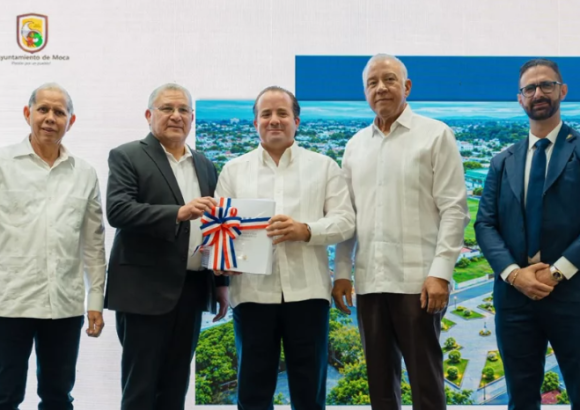
In a public ceremony held Thursday in Moca, the capital of Espaillat province, Dominican Republic’s Minister of the Presidency José Ignacio Paliza officially unveiled the long-awaited Municipal Territorial Planning Plan (PMOT), a binding, community-informed regulatory framework designed to steer land use and balanced development across Moca and its seven subordinate municipal districts through the year 2036.
The rollout marks a key milestone in the national implementation of Law No. 368-22, the landmark 2022 legislation governing territorial planning, land use, and human settlement management, alongside its accompanying implementing regulations laid out in Decree No. 486-25. Paliza underscored that land is a finite, non-renewable resource, noting that unplanned urban sprawl across the region in recent years has created urgent pressures that demand coordinated, responsible stewardship to avoid irreversible losses of critical natural and economic assets.
As part of the public consultation phase ahead of the plan’s formal approval, local authorities are inviting all Moca residents, community groups, and business operators to review the full draft proposal, which is hosted and accessible to the public through the Moca City Council, and submit feedback, comments, and targeted recommendations to refine the framework before it enters into force.
The plan’s foundational territorial diagnostic, compiled after months of on-the-ground field research and data collection, revealed pressing existing vulnerabilities and misallocations of land that the new policy is designed to address: more than 24 square kilometers of prime, high-yield agricultural land has already been diverted to non-farming uses, eroding the core of the local agrarian economy. Separately, the assessment found 14.7 square kilometers of the municipality’s total land area sits in high-risk flood zones, with 43% of all existing residential and commercial buildings in Moca classified as having high or very high structural vulnerability to flood damage.
To resolve these gaps, the final zoning structure laid out in the PMOT allocates just 9.1% of Moca’s total territory as formal urban land, with an additional 3.2% designated as reserved developable land earmarked for controlled, phased future urban expansion. The overwhelming majority – 87.7% of the municipality’s land – will be classified as protected rural zone, prioritized for sustainable agriculture, native forest conservation, and ecosystem protection.
Beyond zoning rules, the comprehensive plan includes tailored construction standards for each of Moca’s seven municipal districts: Canca La Reyna, Monte de la Jagua, El Higüerito, La Ortega, José Contreras, Juan López, and Las Lagunas. It also outlines 108 targeted actionable initiatives grouped across four core priority pillars: environmental resilience, socioeconomic and cultural advancement, spatial and functional urban organization, and institutional governance capacity building.
Government officials confirmed that full implementation of the PMOT will standardize the administration of construction permits and private investment reviews, channel unplanned urban expansion away from high-risk zones and prime farmland, and safeguard the smallholder and commercial agricultural activities that form the backbone of Moca’s local economy. The long-term strategic vision embedded in the policy frames Moca as a model of orderly, climate-resilient sustainable territory, and a leading regional and national hub for high-value agricultural and livestock production by 2036.
Moca unveils territorial plan to guide urban growth and development through 2036