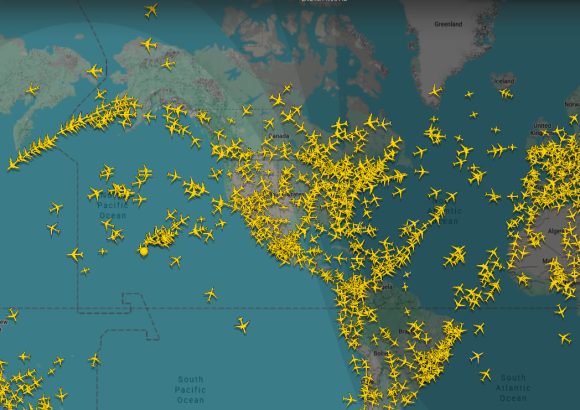
On a recent Friday, the U.S. Federal Aviation Administration (FAA) activated a full nationwide ground stop, pausing all departing commercial and general aviation flights at airports across the country after a widespread telecommunications failure crippled core operations at air traffic control facilities.
U.S. Transportation Secretary Sean Duffy publicly acknowledged the unfolding disruption via a post on social media platform X, clarifying that the communications breakdown was impacting every regional hub responsible for tracking and routing aircraft traveling across U.S. airspace, while on-site FAA technical teams launched an immediate full investigation to identify the root cause of the outage.
In an official formal directive distributed through the Air Traffic Control System Command Center, the FAA justified the sweeping departure halt by citing “extraordinary circumstances and for reasons of safety”, a rare classification reserved for events that pose immediate unmitigated risk to national airspace operations. The outage was confirmed to have impacted all 22 of the country’s regional Air Route Traffic Control Centers, the specialized facilities that coordinate aircraft movement between individual airports to prevent mid-air collisions and maintain orderly flow across the national air network. Initial guidance set the ground stop to remain in place no earlier than 11 p.m. Eastern Time, with administrators noting the timeline could shift as troubleshooting efforts progressed.
Officials moved quickly to reassure the public that the departure halt did not mandate immediate emergency landings for aircraft already in flight. All airborne craft had been fully accounted for, and flight crews were following standardized, pre-approved safety protocols to continue proceeding to their planned destinations. International flights arriving to U.S. territory were being evaluated individually on a case-by-case basis to minimize cascading disruptions to global travel networks.
U.S. Secretary of Homeland Security Markwayne Mullin released a separate public statement to dispel security concerns, confirming that there was no evidence indicating the outage was triggered by a malicious cyber or physical attack, and explicitly ruling out ties to any terrorist plot.
The ripple effects of the ground stop rippled through nearly every major U.S. travel hub, with some of the world’s busiest airports reporting massive backlogs, including Hartsfield-Jackson Atlanta International, Dallas/Fort Worth International, Chicago O’Hare, Denver International, and Los Angeles International. Additional major metropolitan airports facing severe delays included New York’s John F. Kennedy International and LaGuardia Airports, Boston Logan International, Orlando International, and San Francisco International.
The high-profile disruption has reignited long-simmering public and industry concerns about the aging U.S. air traffic control infrastructure, with experts and lawmakers renewing calls for accelerated investment in long-overdue technological modernization of national aviation systems. The incident is the second major nationwide air travel disruption in under two years, following a January 2023 FAA computer system failure that blocked the distribution of mandatory critical safety alerts to active pilots.
Major U.S. airline operators issued public advisories urging all booked passengers to verify the status of their individual flights directly with their carriers ahead of arriving at airports, noting that widespread delays and last-minute cancellations would persist for hours after the official ground stop order is fully lifted, as air traffic teams work to clear the massive backlog of stranded departing flights.
FAA orders nationwide ground stop for departing flights across the United States