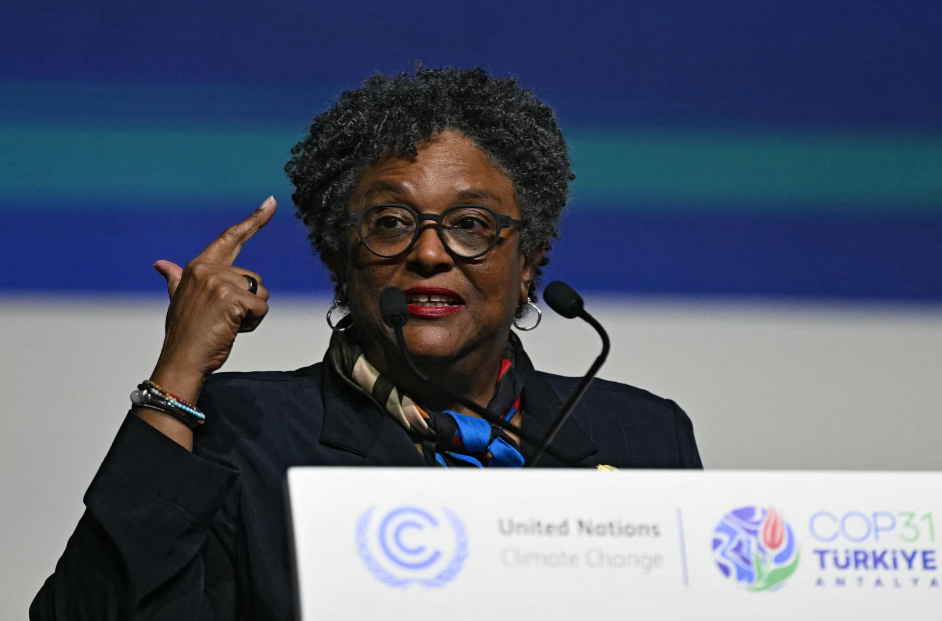
Delivering a fiery, unflinching address at the two-day Antalya Leaders’ Summit of COP31 in Türkiye on Wednesday, Barbadian Prime Minister Mia Mottley tore into the global community’s pattern of making hollow climate promises that never translate to tangible, life-saving support for frontline vulnerable nations. Opening her remarks with a blunt rebuke, Mottley stressed that verbal pledges carry no weight without disbursed funding, noting that current climate finance commitments sit a staggering 70% below previously promised levels. “Let us be under no illusion: no amount of applause in this conference hall has ever rebuilt a single destroyed home in a disaster-stricken nation,” she told the assembled heads of state and global leaders, who gathered under the summit’s official theme of “Towards a Sustainable, Resilient and Equitable Future”. To ground her criticism in real human cost, Mottley cited the catastrophic August 2024 floods in Nepal that killed over 1,400 people and displaced tens of thousands, pointing out that the country had received a mere $20 million from the UN’s landmark Loss and Damage Fund in the wake of the disaster. “A fund starved of actual capital is nothing more than a decorative monument, not a functional support mechanism,” she argued, noting that the paltry disbursement fell laughably short of the expectations that accompanied the fund’s high-profile launch. Speaking in her official capacity as a representative of the V20, the coalition of 55 climate-vulnerable nations advocating for fairer global financial rules and expanded access to climate support, Mottley issued a rousing call for a global grassroots movement dubbed “1.5 Billion Voices for 1.5 Degrees”, urging ordinary people across all sectors of society to hold their governments, financial institutions, and investors accountable for climate inaction. For Small Island Developing States like Barbados, she reminded the audience, the 1.5°C warming limit is not an abstract policy target but a matter of literal survival, encapsulated in the national mantra “1.5 to stay alive”: breaching that threshold would erase coastal communities, destroy livelihoods, and put millions of lives at existential risk. Mottley went on to reference the stark warning she delivered five years prior at COP26 in Glasgow, when she implored global leaders to step up their ambition to protect the 1.5°C goal, noting that the intervening half-decade had seen collective action fall far short of what was scientifically required. Even incremental rises in global temperature, she emphasized, carry devastating, irreversible costs: “One tenth of a degree is a dying coral reef, a failed harvest, a submerged village, and thousands of lost livelihoods.” She closed her address with a direct challenge to the assembled leaders, urging them not to be remembered as the generation that documented the climate crisis with perfect precision but lacked the courage to take the decisive action needed to avert its worst outcomes before the next COP32 summit convenes in 2026.