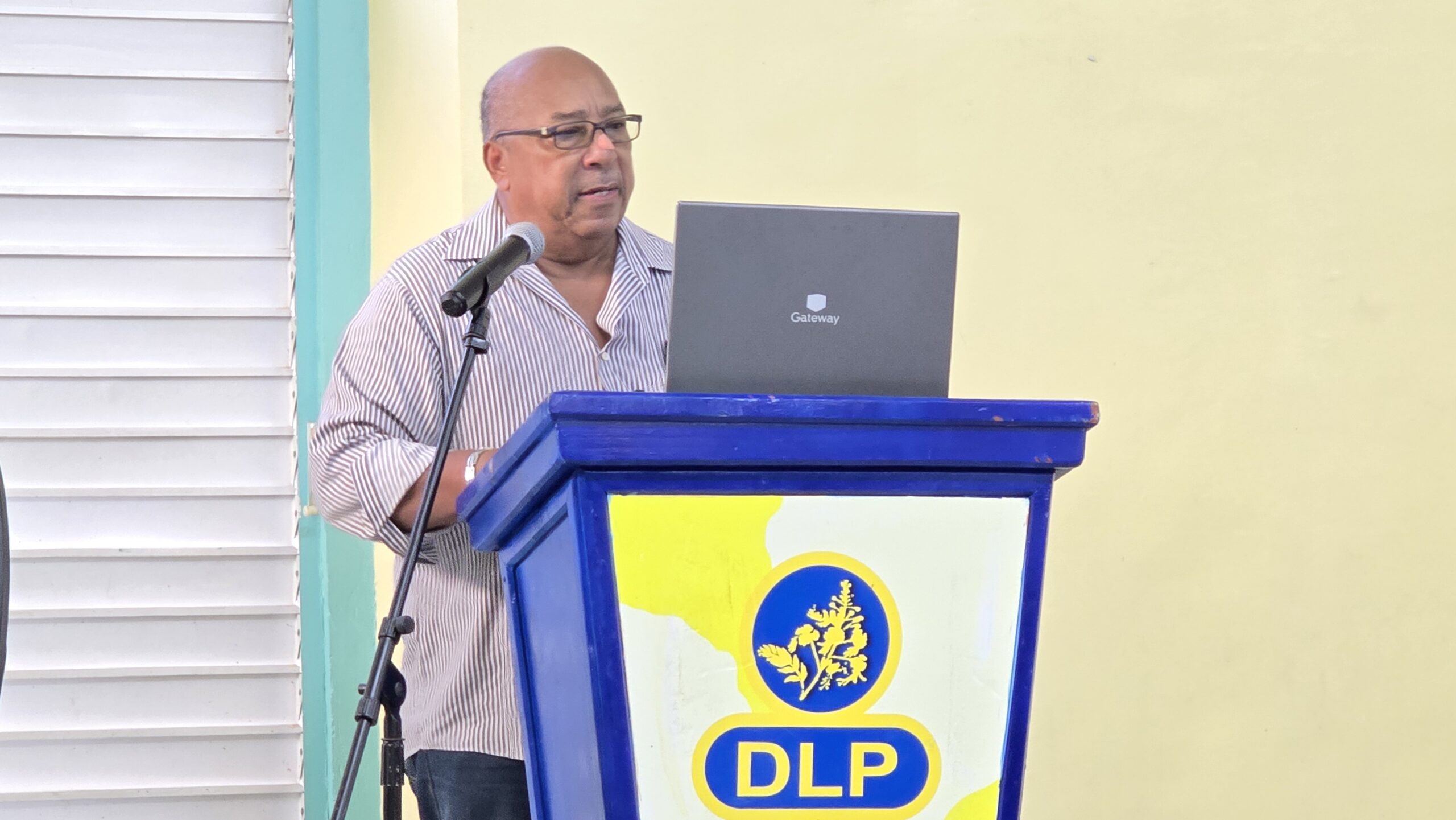
At a packed Democratic Labour Party (DLP) St Michael East branch gathering hosted at St Giles Primary School over the weekend, former Barbados Minister of Economic Planning and Development Dr David Estwick laid out a sweeping, state-centered economic blueprint tailored to address the island nation’s structural disadvantages as a small developing economy.
At the core of Estwick’s argument is the rejection of the long-touted model that frames the private sector as the sole engine of national growth. He emphasized that Barbados, with its limited geographic footprint, cannot compete with large global economies on production volume or unit pricing, rendering unregulated free trade fundamentally inequitable for local stakeholders. The existing domestic private sector, he noted, is not only comparatively small in scale but also inherently risk-averse, leaving it ill-equipped to absorb the thousands of skilled graduates emerging annually from the Barbados Community College, University of the West Indies, and Samuel Jackman Prescod Institute.
Dubbing his proposed system a hybrid of democratic socialism and state-led capitalism, Estwick outlined a clear division of roles where the public sector leads strategic, long-term economic expansion, while private enterprises operate in complementary partnership rather than being tasked with carrying development alone. He pointed to national fiscal data showing total projected government spending of $4.2 billion within a $5 billion national economy, arguing that this existing large public footprint justifies formalizing the state’s central role rather than pursuing privatization of critical public services.
Key pillars of the proposal include the establishment of a new Barbados Development and Investment Bank, a deliberate callback to the original Barbados Development Bank launched under the Errol Barrow administration in 1963, which operated from 1969 until its 1995 insolvency under the weight of non-performing loans. Estwick criticized the prior decision to sell off the Barbados National Bank, noting that the 1998-founded Enterprise Growth Fund Limited, set up by the Owen Arthur administration to fill the gap in public development financing, has not delivered the broad, long-term strategic support local industries require. Under his framework, the Central Bank of Barbados would also expand its mandate beyond purchasing government treasury bills during revenue shortfalls, using domestic currency to fund high-impact, long-gestation projects that drive sustained economic activity.
Estwick further proposed binding national legislation mandating that all public institutions, from hospitals, prisons, and public schools to state agencies, source no less than 60% of their procured goods from local producers. This procurement policy would be paired with a reformed welfare system, where benefits are disbursed via dedicated payment cards instead of traditional vouchers, and recipients earn a 10% to 15% bonus incentive when they use their benefits to purchase domestically produced goods, ensuring public funds circulate to support local farms, manufacturers and small businesses rather than flowing to imported products.
To address persistent cost-of-living pressures, Estwick also called for the creation of a multi-stakeholder Inflation Stability Commission, with representation from private industry, organized labor, independent economists, and ordinary consumer advocates. The body would track price fluctuations for essential household goods, set clear public thresholds for unacceptable price hikes, and trigger targeted Central Bank intervention when those limits are breached, pushing back against the common misconception that a slowing inflation rate translates to falling consumer prices.
He stressed that the state must never withdraw from delivering critical public services that the private sector cannot operate profitably, including Queen Elizabeth Hospital care, public transit, polyclinic healthcare, road infrastructure, social housing, drainage systems, and core welfare support, as these services would otherwise disappear entirely without public intervention.
Estwick calls for state-led growth, development bank