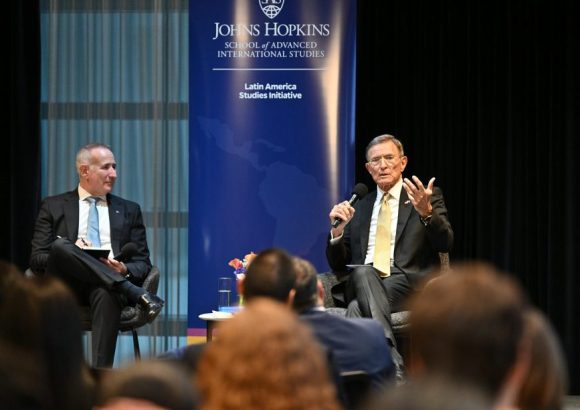
Veteran Dominican diplomat and former six-year foreign policy chief Roberto Álvarez recently completed a high-profile multi-stop visit to Washington, D.C., that bridged academic reflection, high-level regional diplomatic engagement, and archival knowledge preservation. Álvarez, who holds the titles of ambassador emeritus and proud alumnus of the Johns Hopkins University School of Advanced International Studies (SAIS), headlined a featured session at the institution’s annual Latin American Studies Program gathering, hosted at the downtown D.C. Bloomberg Center. The on-stage conversation, moderated by long-time SAIS affiliate Jim Marckwardt, drew a cross-generational audience of faculty, current graduate students, and global alumni, and spanned three core thematic pillars: the deep, long-standing bilateral partnership between the Dominican Republic and the United States, the underrecognized leverage small and mid-sized nations can wield on the global stage through intentional, alliance-centered diplomatic strategy, and the urgent gaps in coordinated international action to resolve the long-running, multifaceted humanitarian and security crisis in neighboring Haiti. Álvarez also walked attendees through one of the most persistent domestic policy tradeoffs his administration navigated in office: reconciling binding international trade commitments under the CAFTA-DR free trade framework with urgent national food security priorities, using the Dominican Republic’s regulated rice market as a concrete case study to illustrate the tensions between cross-border commercial obligations and protecting local smallholder farmers and stable domestic food supplies. Beyond his academic engagement at SAIS, Álvarez held a closed-door bilateral meeting with Organization of American States (OAS) Secretary General Albert Ramdin, where the two senior diplomats mapped out pressing regional priorities. Their wide-ranging talks covered fast-moving political and security developments in Haiti and Nicaragua, ongoing efforts to shore up transparent, inclusive electoral processes across the Western Hemisphere, and shared structural threats to democratic governance that span the Americas. The pair also identified new, untapped avenues for targeted multilateral cooperation to address cross-border regional challenges, from migration flows to climate-related displacement. Ramdin publicly lauded Álvarez’s decades of on-the-ground diplomatic experience and nuanced, pragmatic perspective on regional affairs, while Álvarez formally reaffirmed his longstanding commitment to collective cross-national efforts to strengthen democratic institutions, human rights protections, and accountable governance across the Americas. A notable, lesser-publicized component of Álvarez’s OAS visit was his formal donation of two newly compiled archival volumes to the organization’s historic Columbus Library. The two publications systematically document the Dominican Republic’s full suite of diplomatic actions in response to the unfolding Haitian crisis, covering two distinct time periods: 2020 to 2024, and the planned policy roadmap for 2024 to 2026. The collections bring together hundreds of official diplomatic speeches, formal government position papers, and documented cross-border and multilateral diplomatic initiatives, creating a permanent, publicly accessible archival record that preserves the Dominican Republic’s policy decision-making for researchers, future diplomats, and civil society actors for decades to come. During his public remarks at SAIS, Álvarez took time to reflect on how his own graduate training at the institution laid the foundational intellectual groundwork for his six-year tenure leading the Dominican Republic’s foreign ministry. He specifically recalled a formative 1983 lecture delivered by renowned SAIS Professor Simon Serfaty on U.S. foreign policy doctrine and the geostrategic centrality of the Strait of Hormuz, noting that the session helped build the structured historical and geopolitical analytical framework he relied on to navigate complex, high-stakes international negotiations throughout his time in office. He closed his public address by emphasizing that effective, legitimate public policy decision-making – particularly in high-stakes diplomatic roles – demands three non-negotiable pillars: full public accountability for actions and outcomes, a willingness to openly acknowledge missteps and adjust course, and the consistent ability to translate abstract academic theoretical knowledge into pragmatic, context-aware diplomatic solutions that deliver tangible results for ordinary citizens. For additional people-focused regional news, audiences can access DominicanScope’s full dedicated coverage.
Former Dominican Foreign Minister discusses diplomacy, Haiti and U.S ties in Washington