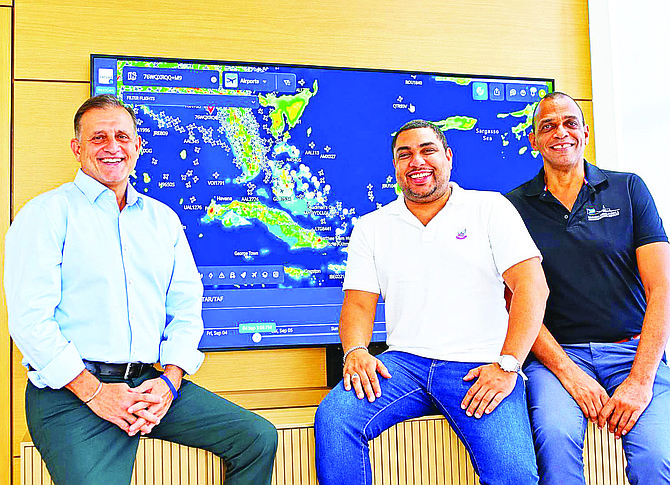
The Bahamas Aviation, Climate and Severe Weather Network (BACSWN) has forcefully refuted recent allegations from a leading U.S. aviation lobby group that the organization plans to impose new charges for services already delivered by the U.S. Federal Aviation Administration (FAA), labeling the claims “manifestly false and demonstrably so.”
Patrick Rollins, BACSWN’s President and CEO, clarified that the initiative’s core mission has never involved duplicating existing FAA offerings. Instead, the project is designed to resolve long-unaddressed aviation safety gaps stemming from a critical lack of real-time weather data for flights traversing Bahamian airspace — a hazard formally documented in official federal aviation assessments.
Rollins directly called on Chris Sununu, head of U.S. airline trade group Airlines for America (A4A) who first raised the fee-related concerns last week, to conduct a full review of the FAA’s Tactical Operations Committee report titled “Recommendations to Improve Operations in the Caribbean.” The document explicitly flags severe deficiencies in real-time meteorological data coverage for users of Bahamian airspace, which falls under the Miami Oceanic flight information region. The gaps, the report notes, create measurable safety risks, and also limit the full operational capacity of major U.S. airports including Miami and Fort Lauderdale-Hollywood International, whose flight paths are constrained by the unaddressed gaps in the surrounding sovereign Bahamian airspace. The FAA report states in explicit terms: “the lack of weather radar presentation, within airspace overlying the Caribbean area of Miami ARTCC (ZMA), creates a safety hazard.”
Sununu had previously raised objections to overflight fees collected by the Bahamas Air Navigation Services Authority (BANSA), and claimed BACSWN was developing an unneeded, unsolicited weather service that the global aviation community had never requested. Rollins dismissed those assertions as entirely unsubstantiated, noting they directly contradict both the Chicago Convention on International Civil Aviation and the FAA’s own published findings. “For Mr. Sununu to suggest these services are not needed — or indeed not required under the articles of the Chicago Convention — is not only factually incorrect but an insult to the sovereignty of our archipelagic nation,” Rollins stated. He emphasized that, like all sovereign nations, The Bahamas bears mandatory international obligations to guarantee the safe, efficient passage of every flight crossing its 173,000 square miles of strategically positioned national airspace.
Under a Heads of Agreement signed with the Bahamian government in May 2025, BACSWN has been designated the country’s official civil aviation meteorological service provider, with exclusive authority to develop, staff, fund, and administer fee structures for the Caribbean’s first purpose-built next-generation aviation weather center. Once fully operational, the facility will deliver round-the-clock real-time flight tracking data, support coordinated search and rescue operations, and maintain continuous 24/7/365 monitoring for hazardous weather events and in-flight obstacles that pose risks to all aircraft operating in Bahamian territory.
In a parallel official statement released recently, The Bahamas Ministry of Energy, Utilities and Aviation confirmed that BANSA is holding productive, good-faith technical discussions with aviation industry stakeholders to resolve remaining disagreements over the national overflight charging framework. While specific details of the ongoing negotiations remain confidential, the ministry confirmed all parties are aligned on the core goal of advancing fair, functional rules for air navigation services. As a signatory to the Chicago Convention, The Bahamas is committed to aligning all fee structures with Article 15 provisions, as well as the International Civil Aviation Organization’s (ICAO) four core principles for air navigation and airport charges: non-discrimination, clear cost correlation, full transparency, and proactive consultation with end users. The government has committed that any future fee arrangements for aeronautical meteorological services will also strictly adhere to these global standards.
Minister of Energy, Utilities and Aviation JoBeth Coleby-Davis emphasized the deep, longstanding partnership between The Bahamas and the U.S. aviation sector, noting U.S. carriers play a critical role in connecting the island nation’s scattered communities to global travel networks and supporting local households and tourism-dependent businesses. “We have listened closely to their concerns, and remain fully committed to working through all outstanding issues in a constructive, collaborative manner,” Coleby-Davis said. “Our core duty is to ensure any final charging framework is fair, transparent, directly tied to the actual cost of services delivered, and developed through full consultation with all users. We will continue these discussions in good faith, recognizing our shared priority of safe, reliable air connectivity and the long-term strength of our bilateral aviation relationship.”
BACSWN dismisses claims by US airline lobby group