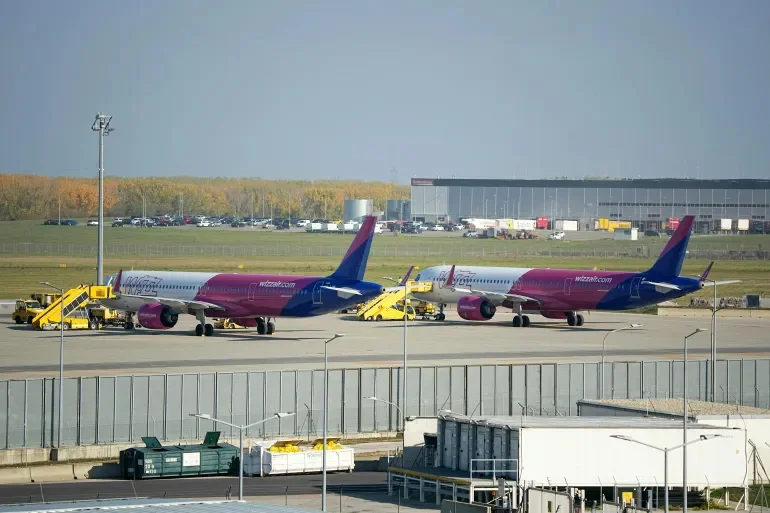
Starting earlier this week, a cascading series of false bomb threats targeting commercial air travel has triggered widespread disruptions across European airspace, drawing military interception responses, cross-border security coordination, and growing alarms from experts and policymakers that the coordinated campaign may be a deliberate hybrid warfare tactic to destabilize the continent.
The spate of threats first emerged on Tuesday, when roughly six passenger flights across multiple European nations received bomb hoaxes. By Thursday, that figure had surged to over 25 affected flights, including four services arriving and departing from Vienna’s Schwechat Airport in Austria. The wave of threats continued into Friday, November 6, with dozens more reports logged across the continent targeting carriers ranging from Ryanair, Wizz Air, and Finnair to LOT Polish Airlines and Aer Lingus.
None of the targeted aircraft or airport facilities have yielded any actual explosives or suspicious items following exhaustive sweeps by bomb disposal teams, but the threats have prompted drastic safety protocols. In multiple incidents, NATO and national air forces scrambled fighter jets to escort diverted commercial flights to alternate landing sites. One Aer Lingus service traveling from Dublin to Rome was rerouted to the French military base at Évreux, with French fighter jets deployed to intercept and accompany the plane before it was searched by explosive experts. A Finnair flight from Helsinki to Rome received sequential escort from Croatian then Italian military jets, while three Ryanair flights bound for Bulgaria were diverted, with one service from London re-routed to Plovdiv and the other two landing safely in Sofia. Additional diversions sent flights to airports in Vienna, Bucharest, and Venice, with most services permitted to resume their original itineraries once full security clearances were completed.
On Friday, new threats continued to roll in: Danish authorities investigated hoaxes targeting air traffic near Copenhagen that prompted no immediate evacuation or airport shutdown, Czech police logged bomb threats against nine arriving and departing flights at Prague Václav Havel Airport with no cancellations required, and French officials confirmed four new threats against aircraft in French airspace, all of which landed without incident. A Wizz Air flight departing Prague for Rome was diverted to Venice as a precaution, while a Ryanair service from Rome to Lisbon landed safely at its scheduled destination.
Notably, the scope of the threats expanded beyond aviation on Friday, with major media outlets across Ireland and Bulgaria receiving identical security warnings. Irish public broadcaster RTÉ ordered all staff to evacuate its Dublin headquarters, while UK network Sky News also reported a credible security alert. The threatening messages, which warned of imminent attacks on European transport infrastructure, were sent under the pseudonym “Mikhail Andropov,” though authorities have not verified the sender’s true identity or geographic origin.
The coordinated, cross-national nature of the campaign has led senior European officials to raise the possibility of state-sponsored hybrid aggression. Spanish Foreign Minister José Manuel Albares noted that the near-simultaneous, structurally identical incidents across a dozen unrelated European countries could not be dismissed as random coincidence, pointing to hallmarks of psychological warfare designed to sow public unrest. These concerns align with a recent pattern of high-profile sabotage and cyberattacks targeting European critical infrastructure, including disruptions to power grids, defense sites, and retail supermarket systems that multiple EU governments have previously attributed to Russia. Moscow has repeatedly denied any involvement in such operations, and to date no concrete evidence has formally linked the ongoing bomb hoax campaign to the Russian state; investigators also have not ruled out the possibility that some of the threats are copycat submissions from independent actors with personal motives.
The crisis has now taken on a formal military dimension: Hungarian Defense Minister Romulusz Ruszin-Szendi confirmed that multiple passenger flights over Hungarian airspace, including services from Brussels to Sofia and Prague to Bucharest and Cyprus, received military fighter escort on Friday. For the first time, officials confirmed that NATO has launched dedicated enhanced air patrols along the Hungary-Romania border, marking the alliance’s direct operational involvement in responding to the hoax campaign. The European Commission has also activated its cross-border aviation security information sharing mechanism to enable national law enforcement and security agencies to coordinate investigations and identify potential links between individual threats.
Even with zero confirmed casualties or actual explosive finds, the cumulative impact of the hoaxes has been substantial. Thousands of passengers have faced unplanned diversions, multi-hour delays, missed connecting itineraries, and pervasive travel uncertainty. Airlines and airport operators have incurred steep unbudgeted costs deploying additional security personnel, re-routing aircraft, and pausing normal operations to facilitate full aircraft and terminal sweeps. Industry analysts warn that sustained repeated threats risk eroding public passenger confidence in European air travel, while security experts note that the campaign’s secondary goal may be to stress-test European security response protocols and drain limited law enforcement and military resources. European authorities now face a dual challenge: upholding rigorous safety standards for civil aviation, while preventing a sustained wave of unsubstantiated hoaxes from causing long-term, systemic disruption to cross-continental travel. As of press time, no single group or individual has been definitively identified as the orchestrator of the broader threat campaign, with cross-national investigations still ongoing.
Golf van bommeldingen ontregelt Europees vliegverkeer