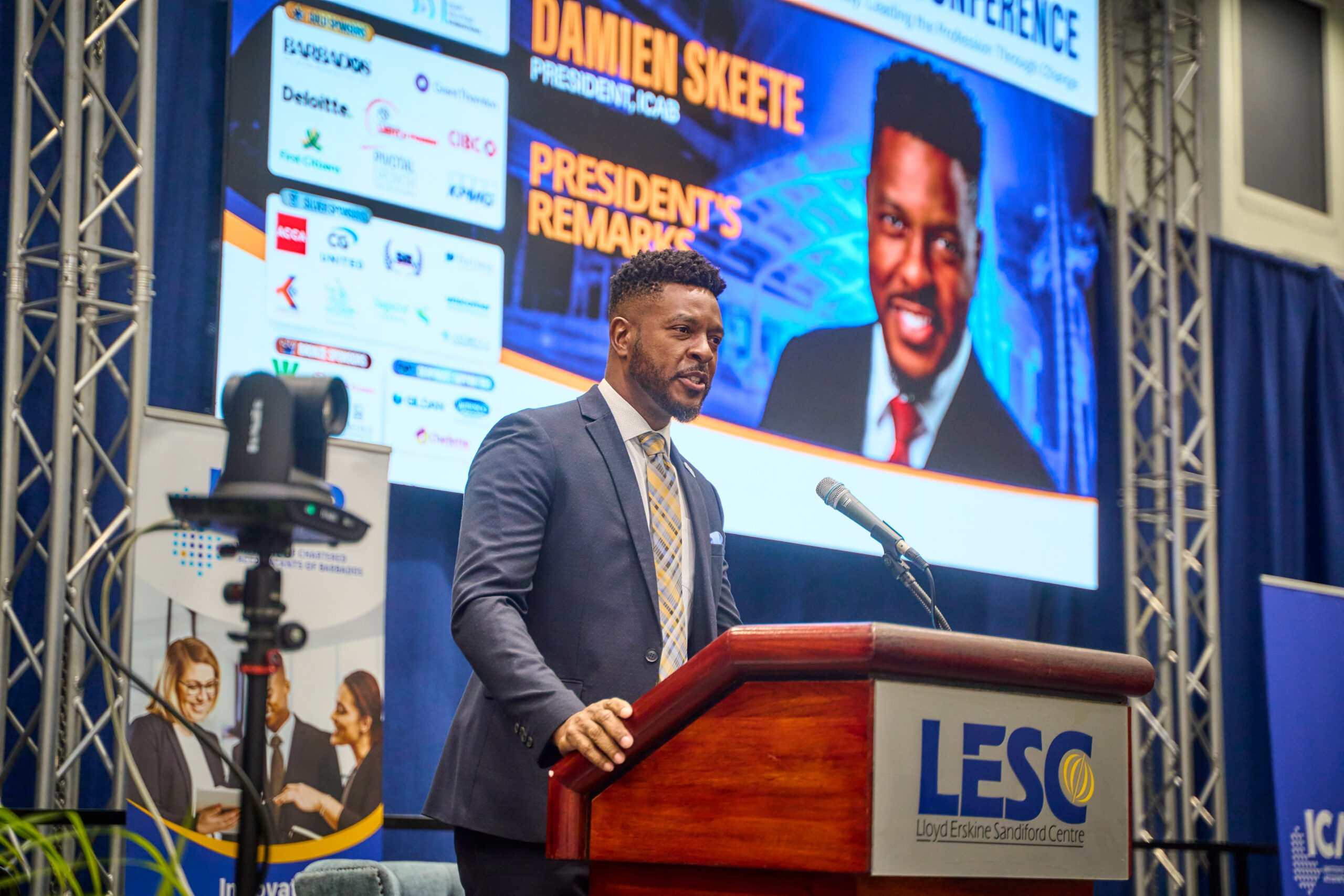
Delivering a keynote address at the Institute of Chartered Accountants of Barbados (ICAB) annual gathering held at the Lloyd Erskine Sandiford Centre last Friday, ICAB president Damien Skeete laid out a clear vision for the future of the island’s accounting sector, framing rapid artificial intelligence and data analytics adoption as both a transformative opportunity and a key test of the profession’s long-standing commitment to public trust. Skeete outlined how emerging AI tools have already upended traditional auditing workflows: processes that once required entire teams of chartered accountants to manually sift through thousands of individual transaction records can now be augmented by intelligent systems that scan full datasets in real time, flag hidden anomalies, surface emerging operational trends, and pinpoint unmitigated risks far faster than manual review processes ever allowed. Beyond streamlining core auditing tasks, Skeete noted that AI is rewriting fundamental frameworks for how financial information is collected, processed, and shared with stakeholders, while also reshaping daily learning patterns, workplace operations, and even professional social interactions across the entire sector. Even as technological innovation unlocks new efficiencies, the regional accounting profession faces a overlapping set of concurrent pressures: rising public and regulatory demands for full transparency and organizational accountability, growing mandatory focus on environmental sustainability and climate-related financial disclosures, persistent talent recruitment and retention hurdles, and lingering cross-border economic volatility. Against this complex operational landscape, Skeete emphasized that certified accountants hold a uniquely advantageous position to guide local businesses toward robust, data-backed strategic decisions, drawing on their deep specialized expertise in risk mitigation, corporate governance, and performance tracking. He invoked a folksy family adage to drive home the sector’s broad value, noting “as my grandmother would say, we are no one-trick pony”, before highlighting that trust remains the accounting field’s unmatched competitive advantage. This year’s ICAB conference operates under the core theme “Future Ready: Leading the Profession Through Change”, with scheduled sessions designed to explore three priority focus areas: upskilling pathways for accountants to meet evolving modern business requirements, the operational and reporting implications of climate action and natural capital accounting for local organizations, and the tangible operational benefits of centering neurodiversity inclusion to build stronger, more innovative workplace teams. Skeete told assembled industry delegates that the entire conference program is structured to unpack the single most critical question facing the sector today: how can Barbados’ accounting profession retain its relevance, build long-term organizational resilience, and uphold its decades-long reputation for public respect as market conditions shift rapidly? He argued the solution is straightforward: “The answer lies in our willingness to learn, adapt, and to lead.” Skeete also tied the profession’s evolution to Barbados’ ongoing national milestones, noting that as the nation marks 60 years of independence and five years as a republic, it will continue to rely on strong public institutions, adaptive resilient businesses, and ethically grounded leaders to drive inclusive national progress – and chartered accountants have a non-negotiable central role in supporting all three pillars of national development. He closed his keynote with a call to action for all attendees, urging the sector to “commit to being future ready, not only for our own success, but for the benefit of the businesses, communities, and the nation we proudly serve.”