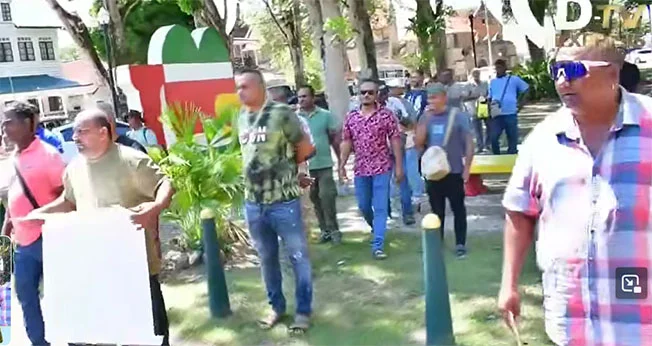
On November 3, local Suriname time, reports from Starnieuws detail a long-simmering dispute between private ferry operators running critical water transit routes between the Commewijne district and the capital Paramaribo, and the national government, that boiled over into a formal protest earlier that week. After six to seven years of operating at a fixed passenger fare of 13 Surinamese Dollars while fuel costs, vessel maintenance expenses, and operational overhead have surged dramatically, the group of small boat owners say they have exhausted all routine administrative channels to seek relief, prompting them to march to the presidential office of head of state Jennifer Simons on Monday to demand direct dialogue.
When the delegation arrived, President Simons was not present at the facility, but the group was received by a team led by Edgar Dikan, a senior staff member attached to the presidential cabinet. Following extended negotiations, Dikan secured an agreement from the operators to resume full ferry services immediately, after giving a formal pledge that the administration would move quickly to deliver tangible resolutions to their longstanding complaints.
Annie Sadie, who serves dual roles as the chair of the Commewijne Private Boat Operators Association and a sitting national parliamentarian, emphasized that the operators have repeatedly submitted formal requests to the national transport ministry over multiple successive administrations, only to be met with unfulfilled promises and no actionable progress. She called out what the group describes as unfair discriminatory treatment, noting that private bus operators and other land-based transport providers have received targeted government financial support to offset rising operating costs, while the water transit sector has been completely excluded from equivalent assistance programs.
The association has put forward two acceptable pathways for a resolution: either the government approves a realistic, cost-aligned fare adjustment, or it provides direct financial subsidies to the operators to cover their growing operational gaps. Sadie stressed that the group is not pushing for an unrestricted steep fare hike that would place the full cost burden on passengers, as the daily ferry services are a lifeline for thousands of low-income commuters including market vendors transporting fresh produce to Paramaribo markets, students traveling to city schools, and other local residents who have no viable alternative transit option. The association previously submitted a detailed cost-calculation based fare adjustment proposal to the transport ministry roughly one month before the protest, and initially received positive signals that an agreement could be reached, only to be later informed that their proposed rate would not be approved – a setback that drastically escalated the group’s frustration.
Beyond the fare dispute, the operators have also faced 15 years of crippling bureaucratic red tape surrounding license applications, renewals, and transfers. Sadie explained that even when a boat owner wishes to legally transfer their operating license to a child or immediate family member to continue the family business, they face endless, unnecessary administrative hurdles that delay or block the process entirely. While the association fully supports strengthened passenger safety regulations including mandatory vessel insurance requirements, Sadie noted that any new regulatory mandates must be paired with financial support for small operators who cannot afford sudden new compliance costs on their current tight margins.
The unannounced work stoppage on Monday caused significant unexpected disruption for commuters, a outcome that Sadie said the operators deeply regret, but emphasized that the group took the extreme step only after years of inaction, noting that the operators themselves lost all income for the day when they suspended services. Tensions briefly flared during the visit to the presidential compound when security staff initially only allowed four representatives from the entire operator group to enter for discussions, a restriction the group pushed back against as they sought full transparency for all members on the status of government commitments.
Sadie also highlighted that the Commewijne district’s economy is rapidly expanding, with new port infrastructure development and growing volumes of heavy equipment and cargo moving through the area, making the water ferry routes far more economically critical than government officials currently acknowledge. She noted that the only alternative land route to Paramaribo is a frequently congested bridge, leaving most local residents fully dependent on the private boat services for daily travel. She explicitly stated that the association’s protest actions are not politically motivated, and that she is advocating for both the survival of the small boat operating businesses and the reliable, affordable transit access that Commewijne residents rely on. The group has stated they will no longer participate in endless, unproductive rounds of talks, and are demanding concrete, formal government decisions on fair fares, streamlined licensing processes, and targeted sector support immediately.