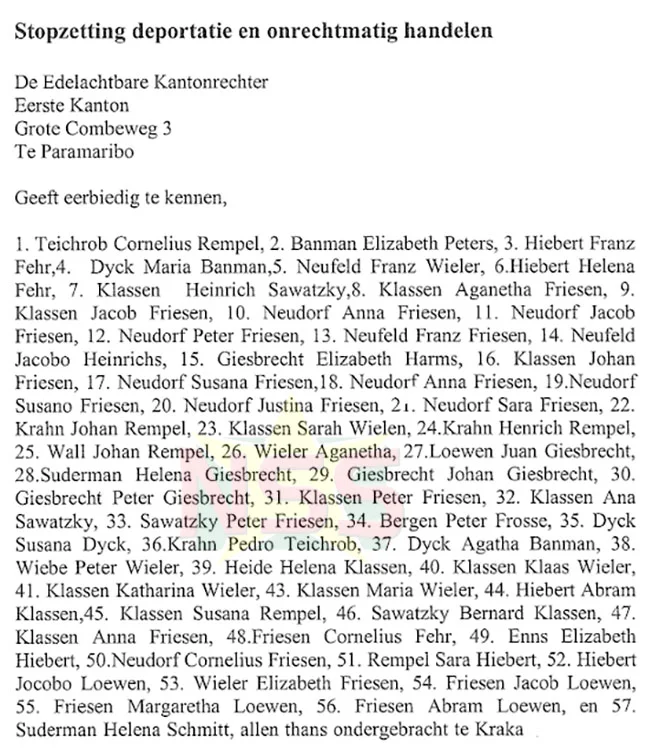
On October 29, local Suriname time, human rights and immigration attorney Derrick Veira formally submitted a second emergency interim injunction petition on behalf of a community of Mennonite residents to the First District Cantonal Court, seeking an immediate stay of planned state deportation proceedings targeting 63 community members. The high-stakes case is scheduled for a formal hearing on Monday, November 2, marking a direct legal challenge from the affected foreign residents themselves, filed just hours after a separate related legal bid was dismissed earlier that same day.
The newly filed petition, titled “Halt of Deportation and Unlawful State Conduct”, represents Mennonite families currently residing in the Kraka settlement in Para District. Legal filings outline that the community originally entered Suriname to launch a government-endorsed large-scale agricultural development project, operating under formal prior state approvals, a formal public-private partnership framework, and with tens of thousands of dollars in already deployed capital for farm infrastructure, equipment, and imported supplies. Veira emphasized that the Mennonite community operated under the explicit reasonable good-faith assumption that they would be permitted to carry out their agricultural operations long-term in Suriname, per formal commitments from national authorities.
The legal submission also raises formal objections to law enforcement actions carried out on October 28, when armed police units conducted a sweep of the Kraka settlement. Veira alleges that community members were detained and separated from one another during the operation, with restricted access to legal counsel and due process protections guaranteed under Surinamese law. The filing warns that the ongoing lack of independent oversight over the detained group risks creating a public health and humanitarian crisis, particularly for vulnerable members including infants, children, and elderly family members.
Additional core arguments in the lawsuit note that the Mennonite families had previously submitted formal applications for short-term residency permits, which were administratively rejected; a formal request for presidential review of that residency rejection is currently pending, and Veira argues that no deportation can lawfully proceed until that executive review process has reached a final decision. The legal team further underscores that immediate deportation would result in irreversible total loss of all the community’s on-the-ground agricultural investments, which were made under the explicit invitation and prior approval of Suriname’s governing bodies.
This second legal action comes on the heels of a ruling earlier on October 29 from Cantonal Judge Deborah Haakmat-Sniphout, who dismissed an earlier injunction petition filed by Suriname Green Energy Agriculture N.V. (SGE), the private corporate partner on the Mennonite agricultural project. In that earlier ruling, the judge determined that the private company’s economic interests did not override the Surinamese state’s legal authority to enforce national immigration laws, as the affected Mennonite residents did not hold valid, current residency permits. The court did not issue an explicit order approving deportation, but also declined to impose any temporary ban on state removal operations.
Suriname police spokesperson Michel Elskamp confirmed that law enforcement agencies are moving forward with active deportation preparations, noting that the group of 63 people in custody includes three infants. Authorities are currently arranging a dedicated charter flight for the removals, though no official departure timeline has been publicly disclosed. The new direct legal petition from the Mennonite community is designed to let the court assess their individual legal residency claims and human rights protections directly, rather than adjudicating the matter through the lens of the private corporate partner’s economic interests.