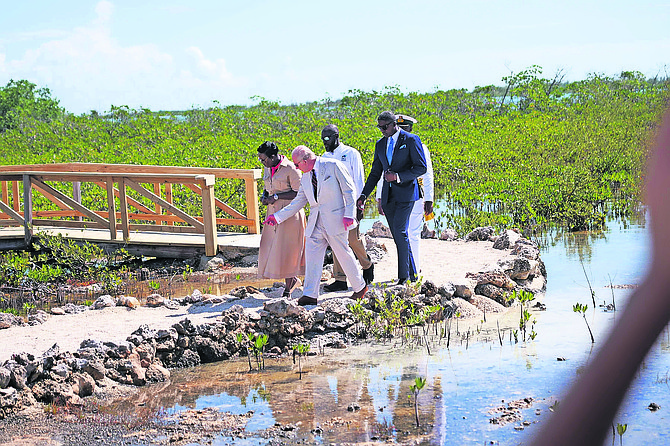
During his landmark three-day inaugural visit to The Bahamas as reigning monarch, King Charles III took a uniquely hands-on role in exploring Bonefish Pond National Park on New Providence’s southern coast last week, to the point that Bahamas National Trust (BNT) leadership noted he effectively co-directed the entire guided experience. As the official royal patron of the BNT, the King arrived ready with targeted, informed questions for on-site conservation staff, delving deep into mangrove ecosystem health, native wildlife populations, and the critical role these coastal wetlands play in shielding local communities from devastating storm surges. BNT Executive Director Lakeshia Anderson-Rolle shared that the depth and specificity of the King’s inquiries aligned perfectly with the tour’s core educational and conservation-focused objectives, leading the team to joke that he “partially led the tour” rather than following a pre-planned script entirely. Before embarking on the private boardwalk traversal that local media were not permitted to join, the King, dressed in a tailored grey suit and sunglasses, held brief introductory discussions with three Bahamian cabinet ministers: Environment Minister Zane Lightbourne, Housing Minister Keith Bell, and Minister of State for Immigration Darron Pickstock, covering cross-cutting policy priorities tied to their respective portfolios. Spanning 1,235 acres, Bonefish Pond is one of 33 protected national parks managed by the BNT, established in 2002 on a site that had previously been used as an unregulated illegal dumping ground; today it serves as a critical nursery habitat for hundreds of marine species that later migrate out to adjacent coral reef systems. Midway through the 650-foot elevated boardwalk route, the King stopped at a waterfront pavilion where students from four local high schools—LW Young High School, Bahamas Academy, Anatol Rodgers High School, and CV Bethel Senior High School—were participating in hands-on outdoor education activities, including kayaking, snorkelling, and wildlife observation among the mangrove prop roots. He watched a live demonstration of a withal collector, a specialized scientific tool used to track juvenile marine species in the wetland ecosystem, and spent extended time asking staff about student participation rates in the park’s youth education programs, even taking a moment to speak one-on-one with Bahamas Academy’s head boy, who described the encounter as a deeply exciting, memorable experience. Representatives from three leading regional marine conservation organizations—the Perry Institute for Marine Science, the Bahamas Reef Environment Educational Foundation, and the Bonefish and Tarpon Trust—also joined the tour to share their on-the-ground work with the monarch. To mark the historic visit, the King joined BNT leadership to unveil a custom commemorative plaque, then participated in a traditional tree-planting ceremony, digging in to pack soil around a newly planted silver buttonwood, a mangrove-associated species that acts as a critical first line of coastal defence against rising sea levels and storm damage. Lindy Knowles, BNT’s acting director of science and policy, walked the King through the ecological role of the species, explaining that it grows closest to the high-tide line as one of the final natural barriers protecting inland areas from climate-related erosion. The King asked detailed follow-up questions about the tree’s drought and storm resilience, as well as its maximum mature size, before Knowles pointed out a fully grown, thriving silver buttonwood specimen nearby to illustrate the species’ hardiness. Minister Pickstock emphasized the non-negotiable value of protecting Bonefish Pond, noting that it represents the last remaining intact large mangrove tract on the entire island of New Providence, making its preservation for future generations a top national priority. This park visit formed the central highlight of a royal trip anchored entirely around climate action and conservation advocacy. Shortly after his arrival in The Bahamas on Tuesday, the King delivered a keynote address to youth gathered at Clifford Park, warning that low-lying small island nations like The Bahamas—where 90% of all land sits less than two metres above sea level—face disproportionate, existential risk from global sea level rise and cascading climate hazards. Drawing on more than 50 years of cross-Commonwealth youth engagement work, he urged young Bahamians to take leading roles in building a local, community-centered sustainable future. Bahamian Prime Minister Philip “Brave” Davis noted that the King’s environmental advocacy stretches back decades, pointing out he was one of the first major global public figures to warn publicly about the catastrophic long-term risks of climate change as far back as the early 1970s. Davis added that the high-profile royal visit has generated unprecedented positive international media exposure for The Bahamas, with global leaders and media outlets reaching out from across the world to praise the country’s hospitality and showcase its ongoing conservation efforts. When pressed for details on the total cost of the royal tour, both Prime Minister Davis and Foreign Affairs Minister Fred Mitchell declined to release a specific figure, noting only that all allocated spending is appropriate and responsible, and will not place undue strain on the national budget. Following his departure from The Bahamas, the King is scheduled to travel next to Guyana, before heading to Antigua and Barbuda to attend the Commonwealth Heads of Government Meeting running from November 1 to 4.