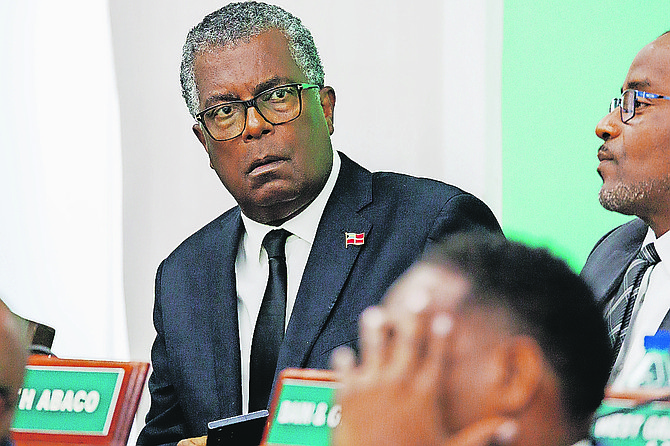
In a sharply worded public rebuke delivered during his weekly Sunday evening voice note address, Bahamas Foreign Affairs Minister Fred Mitchell has pushed back against external actors inserting themselves into the ongoing domestic debate over the restructuring of Freeport’s governing framework, explicitly stating that the fate of the Grand Bahama free trade zone is an exclusively domestic matter with no foreign policy ramifications. The remarks come directly in response to recent public comments from U.S. Ambassador to The Bahamas Herschel Walker, who raised public alarm last week following Prime Minister Philip “Brave” Davis’s official announcement that the administration intends to terminate the Grand Bahama Port Authority’s decades-long governing authority under the 1955 Hawksbill Creek Agreement. Prime Minister Davis laid out the government’s formal proposal last Wednesday, declaring that the existing model for Freeport’s administration will be phased out with no room for further negotiation over the core policy shift. Under the original Hawksbill Creek pact, set to remain in effect until 2054, the privately held Grand Bahama Port Authority — owned by the prominent Hayward and St George families — was granted sweeping authority over all business permitting, construction approvals, and land use planning across the port zone in exchange for broad tax exemptions. The Port Authority has since pushed back against the government’s proposal, insisting that its contractual rights and those of its licensed business partners must be fully respected and can only be modified through mutual, negotiated agreement. The Davis administration has framed the longstanding arrangement as a colonial-era holdover that no longer serves the public interest, noting that the 1955 deal was struck at a time when the country was governed by a small, unelected oligarchy rather than a representative, independent national government. Ambassador Walker, in a published statement last week, said he had reviewed the prime minister’s announcement with “real concern,” arguing that the policy shift would send a troubling signal to global investors that regulatory rules can be altered unilaterally after parties have already committed capital to local projects. While acknowledging that Grand Bahama has long underperformed on economic outcomes, Walker emphasized that international investors prioritize jurisdictions with consistent, predictable regulatory frameworks, and said the government’s announcement had spawned a long list of unresolved questions for existing stakeholders: whether pre-existing tax and duty exemptions, active business licences, and signed commercial contracts would be honoured, which public or governing body would set future operational fees, what formal avenues of appeal would be available to aggrieved parties, and what the full timeline for the transition would be. He also highlighted the scale of existing U.S. investment in Grand Bahama’s post-disaster recovery, citing the $120 million redevelopment of the Grand Lucayan resort, Carnival’s upcoming Celebration Key cruise port, and the Western Atlantic University School of Medicine as major ongoing U.S.-backed projects that stand to be impacted by the regulatory overhaul. This marks the second high-profile public clash between Ambassador Walker and the Davis administration in as many weeks: the previous month, Walker publicly dismissed the Bahamian government’s formal complaint that undercover U.S. drug enforcement agents had operated on Bahamian soil without prior official permission as “fake news.” Minister Mitchell, who also serves as chairman of the ruling Progressive Liberal Party, pushed back hard against the ambassador’s interventions in his weekend address, stating “Some people who are not vested in the city, outsiders to the debate, have entered a debate that is none of their business and of course, the wider point needs to be made that there are no foreign affairs implications in this debate. Neither is there any question of expropriation. Folks should stop crying wolf.” He went on to accuse the Port Authority’s owners of failing to uphold the explicit and implicit promises laid out in the original 1955 agreement, noting that Freeport’s economy has stagnated for decades and the national government has been forced to bear the cost of covering critical public services in the zone for years. Mitchell noted that the administration had previously taken the Port Authority to international arbitration to recoup public funds spent on services the authority was contractually obligated to deliver, with both sides claiming partial victory after the March 2023 arbitration ruling. He went on to label the Port Authority’s leadership “obdurate and recalcitrant,” criticizing the entity for selling off core public-facing assets including the local harbour, international airport, power utility, major resort properties, and the Port Lucaya commercial complex. He specifically called out the ongoing, protracted litigation over Port Lucaya that has blocked investors from redeveloping the once-thriving commercial hub, leaving the site a derelict, underused wasteland that bears no resemblance to its former prosperous state. During a recent on-site visit to Grand Bahama, Mitchell added, he observed that local road infrastructure was in a state of severe disrepair, and the Port Authority’s proposed budget for road upgrades was woefully insufficient to address the backlog of needed repairs, with debris left behind by 2019’s Hurricane Dorian still uncleared across large swathes of the city. Noting that public feedback on the government’s reform proposal has been overwhelmingly positive to date, Mitchell called on Grand Bahama residents to rally behind the planned restructuring, and took aim at opposition Free National Movement leader Michael Pintard, dismissing him as “mealy mouthed” and the “gaslighter-in-chief” for failing to offer clear, unreserved support for the reforms. The government has published a full Green Paper outlining its proposed framework for Freeport’s future at the public portal www.gbframework.com, with a formal public consultation period running from November 1 of this year through April 30, 2027. Mitchell framed the consultation process as a once-in-a-generation opportunity for Bahamian citizens to shape the long-term trajectory of their nation, reinforce the country’s sovereign authority, and drive inclusive national development — a stark contrast to the 1955 Hawksbill Creek deal, which was drafted and implemented with no public consultation or input from ordinary Bahamians.