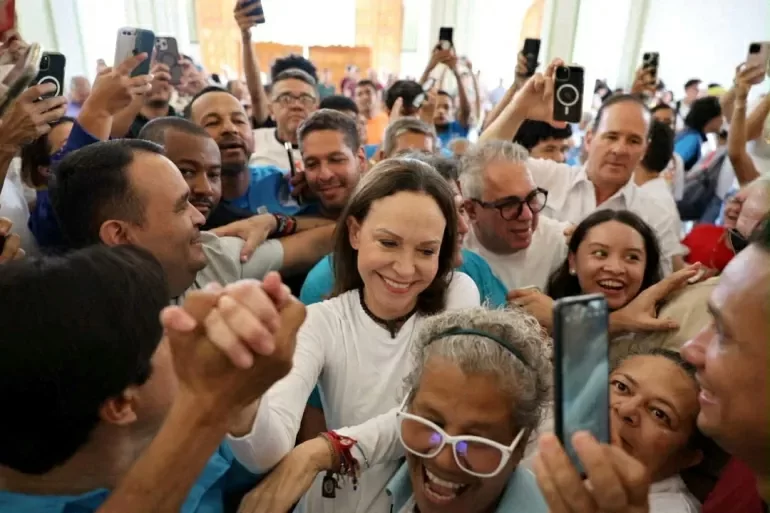
Caracas, Venezuela – October 26, 2026: One of Venezuela’s most prominent opposition figures and 2025 Nobel Peace Prize laureate María Corina Machado has stepped back onto national soil after nearly a full year abroad, landing in the western state of Lara on October 25 to a raucous welcome from hundreds of loyal supporters who gathered at a local church to greet her.
Breaking the news of her homecoming on her official social media channels, Machado posted a simple, direct message: “I am here. With you.” Her return was independently verified by fellow opposition leader Edmundo González Urrutia, the candidate the opposition declared the legitimate winner of the 2024 contested presidential vote, who confirmed he intends to rejoin his supporters inside the country in the coming weeks. Footage of Machado’s arrival was shared widely across social platforms by her political movement Vente Venezuela, though full details of her entry route remain unconfirmed; multiple international press outlets cite sources indicating she crossed overland from neighboring Colombia.
Machado fled Venezuela in late 2025 in secret to travel to Oslo and accept her Nobel Peace Prize, awarded for her years of nonviolent advocacy for democratic governance and resistance to the authoritarian rule of former long-time leader Nicolás Maduro. Prior to her departure, she had spent months in hiding to avoid state persecution, and was briefly detained in January 2025 amid widespread anti-government demonstrations. Representatives for Vente Venezuela note she made repeated, unsuccessful attempts to re-enter the country in the months after she received the award.
The political landscape Machado returns to is drastically different from the one she left. In January 2026, U.S. military forces apprehended Maduro and removed him from Venezuelan territory, installing his former vice president Delcy Rodríguez as interim head of state with explicit backing from the administration of U.S. President Donald Trump. Rodríguez has now held power far beyond the initial 90-day transitional mandate outlined for her, and no official date for new national presidential elections has been announced, sparking widespread public frustration.
Machado’s homecoming follows a wave of historic nationwide protests last week, the first coordinated cross-country opposition demonstrations in nearly two years, where tens of thousands of Venezuelans took to the streets demanding immediate, free, and fair electoral processes. The political crisis traces its roots back to the deeply discredited 2024 presidential election, where Maduro’s government declared itself the winner without releasing full, granular vote tally data. The opposition’s independent vote monitoring efforts concluded González Urrutia had won a decisive majority, a claim backed by dozens of international observer groups. In the post-election crackdown that followed, state security forces launched mass arrests of opposition activists, leading to dozens of confirmed fatalities and thousands of detained dissidents.
Venezuela’s unified opposition bloc is now pushing for official new election timelines that guarantee Machado full, unobstructed ability to participate in public life and run for office if she chooses. The Trump administration, however, has maintained publicly that Venezuela must first achieve sustained political and economic stability before elections can be scheduled, and has continued its close alignment with Rodríguez’s interim government, including negotiating landmark deals to reform the country’s long-collapsed oil industry and roll out sweeping economic restructuring policies.
U.S. Secretary of State Marco Rubio framed Machado’s safe return as a direct outcome of U.S.-backed reconciliation negotiations between opposition factions and the interim government, talks that he said have already led to the release of hundreds of political prisoners and the repatriation of dozens of exiled opposition leaders. Speaking to reporters on the same day Machado arrived, Trump noted he had not been given advance notice of her return, described her as “a very kind woman,” and stated his hope that she would remain safe. The U.S. president has previously expressed public skepticism about Machado’s ability to lead the fractured South American nation, and opted to prioritize a governing partnership with Rodríguez even after Machado visited the White House earlier this year to present him with her Nobel Peace Prize medal, a gesture she framed as recognition of U.S. support for Venezuelan democratic freedom.
While Machado’s physical presence inside the country is set to dramatically escalate public pressure on the interim government to set a firm election date, it remains unclear what formal role she will take in upcoming negotiations over Venezuela’s political future. Opposition leaders have vowed to sustain nonviolent grassroots campaigns until transparent, internationally monitored elections are confirmed, with González Urrutia’s own planned return expected to further galvanize the pro-democracy movement in the weeks ahead.